Christopher Hitchens died in december 2011. I hope one would agree that like him or hate him, he provoked conversation and thought on many profound subjectsfacing our society. I do not see anyone filling that void. There are so many subjects that without review will neither improve or evolve. We can chose to ignore issues, never discuss them, but they don’t go away.
The Greeks, 18th century man, seemed to have been moments in history where discussion was considered a sign of a cultured man.
Author: ws lirakis
SOME DAYS YOU DON’T KNOW WHAT TO POST
OVER ANALYZED?
Not only are we still wondering if the 72 foot catamaran was a good choice for the America’s Cup series; for many reasons, not the least of which is cost. This event has proved just how fragile the boats are. Even the last America’s Cup sailed in Valencia with the technological marvels were very fragile as well. However nothing was apparently learned from that event.
There is also a question of judgement when sailing, knowing when to say no. On the other hand, as I stated, better to push the envelope now and find the limits early.
News yesterday that Artemis damaged their boat towing it without a rig in place.
ONE MORE LOOK
How to put positive spin on a disaster.
ORACLE 72 WORSE THAN WE THOUGHT
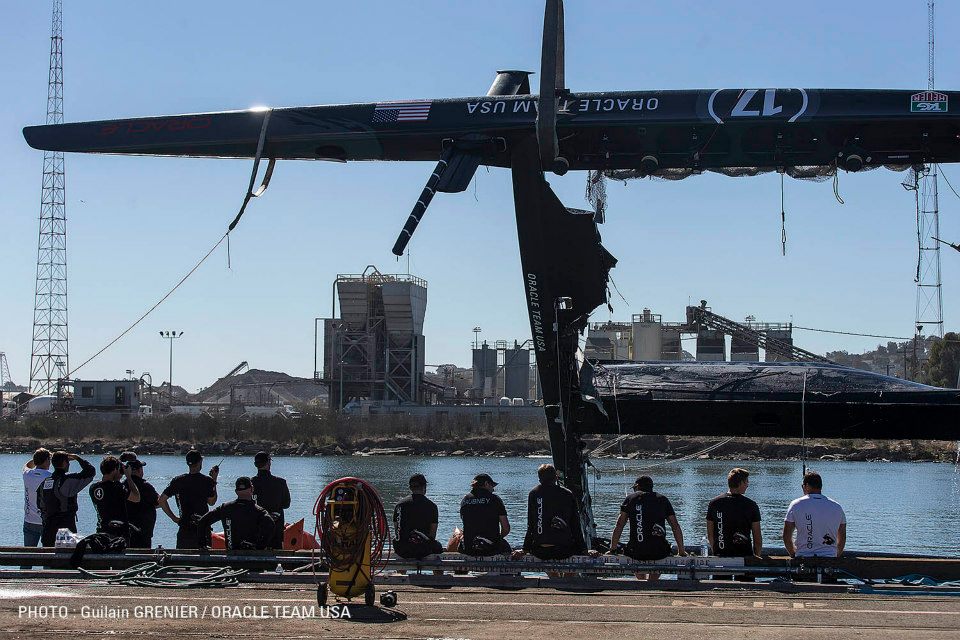
This image should tell the story. Good thing it happened now. The America’s Cup will be a war of attrition; either parts or money.
Towering America’s Cup boat recovered
Will Kane
Updated 4:51 p.m., Wednesday, October 17, 2012
(10-17) 09:58 PDT SAN FRANCISCO — The state-of-the art Oracle Team USA catamaran racing sailboat that flipped during a bay practice run and was dragged out the Golden Gate was brought back to its San Francisco base early Wednesday.
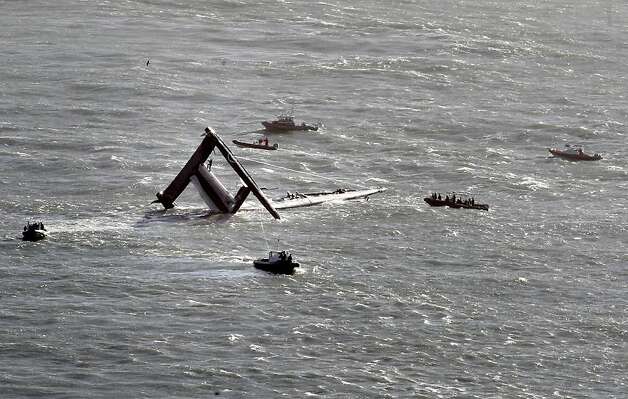
The AC72 racing craft arrived at Pier 80 south of the Bay Bridge around 12:45 a.m., more than nine hours after it capsized off the St. Francis Yacht Club in San Francisco and was dragged upside-down out to sea by a strong ebb tide. Oracle Team USA utility boats towed the boat to shore as the U.S. Coast Guard monitored the operation.
The full extent of the damage to the $8 million carbon-fiber boat was not immediately clear. But team officials said the wing – the long, mast-like apparatus that shoots in the air to catch the wind – was destroyed.
At the team’s base of operations at Pier 80 on Wednesday, crews hauled out the bits of mangled wing sail and began examining the hull of the 72-foot-long catamaran to see what could be salvaged. Early in the day, the boat was still upside-down as crews prepared to lift it out of the water.
“We’re just looking at all the damage and getting some of the loose bits freed up so we can lift (the hull) out,” said team tactician John Kostecki as divers inspected the wreckage.
One of the boat’s hulls was entirely filled with water and the other was almost three-quarters full, he said.
“We’re happy to have the platform, but the wing sail is very damaged,” Kostecki said. “That looks like at the moment to be the biggest setback.”
The boat was hard to lasso when it capsized Tuesday because it pitched forward. Crews had to spend precious hours trying to flip the boat on its side while the boat was being sucked out to sea by a 5-knot current.
Once the crews got the boat on its side, the large, violent Pacific waves tore the wing sail apart.
“The misfortune really was that there was an outgoing sea current that swept the boat into a bigger seaway which caused a lot of damage,” Kostecki said.
“It is the first time one of these AC72s capsized,” he said. “It is kind of new territory for everybody.”
He added, “I don’t think there will be any major changes (to the design of the boat). We still don’t know what went wrong.”
The boat, with a wing height of 131 feet, is supposed to defend the America’s Cup when the competition is held on the bay next year. The 11-member racing crew was out for a practice spin Tuesday when the craft tipped over. None of the sailors was injured.
The Oracle team dispatched nine boats to salvage the AC72, which was swept more than 4 miles west of the Golden Gate.
Will Kane is a San Francisco Chronicle staff writer. E-mail: wkane@sfchronicle.com Twitter: @WillKane
CAPSIZE VIDEO
In today’s world we should not be surprised that there is video. Still very cool that it exists. The 72 foot cats are very powerful; and very fragile. The America’s Cup series may well turn out to be a series of attrition. Last man standing. You cannot win a race if you don’t finish. It also makes it very expensive to have an entry.
Read the story: HERE
BREAKING NEWS: CAPSIZE
Word on the internet is that the oracle 72 foot multihull has capsized. Damage to the wing. Should we be surprised?
This event coupled with Coutts remarks a few days ago:
Yachting: Coutts admits big cat a mistake
5:30 AM Saturday Oct 6, 2012
Coutts conceded if he had his time again he would have gone with a less ambitious design. Photo / NZPA
America’s Cup heavyweights at odds as tension hits boiling point
Russell Coutts, the mastermind behind the format for next year’s America’s Cup, has admitted he made a mistake with the AC72 class rule and revealed he even tried to scale back the size of the boat late last year.
The Oracle chief executive claims his efforts to revise the design of the wingsail catamarans when it became apparent other teams were struggling with the costs and complexity of the project were blocked by Team New Zealand counterpart Grant Dalton.
But, in what is sure to bring simmering tensions between the two teams to boiling point, Dalton has fired back at Coutts, accusing the four-time Cup winner of trying to “spin his way out of trouble”.
Under the original plans for the 34th America’s Cup unveiled in September 2010, competitors were supposed to be racing their AC72s in this week’s world series regatta in San Francisco.
But with just three challengers confirmed for the Cup next year, and only one of them – Team New Zealand – having got their boat wet yet, the remaining regattas on the circuit will be sailed in the AC45s.
The design and construction process of the high-tech wing-sailed catamarans has been far more time consuming and complex than anticipated. Artemis’ AC72 programme has been fraught with problems, while Oracle suffered major damage to their daggerboards shortly after they launched their boat, behind schedule, in late August.
In an interview with the Weekend Herald at Oracle’s base on the outskirts of San Francisco, Coutts conceded if he had his time again he would have gone with a less ambitious design.
“In hindsight, I think there were two errors. One was I thought the boats needed to be quite large-scale to be grand enough for the America’s Cup. Clearly the world series has proven this wrong – the AC45s look pretty damn good on TV,” he said.
“The other thing is, we possibly should have looked at making more of the components one-design.”
Coutts said he broached the topic of moving to a smaller scale boat at a competitors meeting in San Diego in November last year, but the idea was immediately rejected by Dalton.
“Quite a few of the teams were in favour of this, particularly the ones that were struggling financially. Do you know who opposed that? Team New Zealand. And now they’re complaining about how difficult it is.”
But Dalton has rejected Coutts’ account of events, and believes the Oracle chief executive is trying to use Team New Zealand as a scapegoat for his own poor planning.
“(The proposal to change the class rule) was nothing more than a statement made at a closed meeting so that one day when the wheels start falling off he can use it as an excuse,” said Dalton.
“He was proposing that we all scrap three well-advanced boats, and start again.
“It is one of the biggest concessions of defeat I’ve ever heard.”
Coutts asserts when the idea was tabled no team had begun building their AC72s, but Dalton denies this.
“At that point our boat was three-quarters built. His boat and Artemis were well in build. Deals were done.
“And what would that have meant (if we did agree to change the class rule)? That all these other teams were suddenly going to stump up the money?
“They can barely even start an AC45.”
With this latest spat following a stand-off between Team New Zealand and America’s Cup event organisers this week over a decision to abandon development of the team bases on piers 30-32, it appears the rare period of peace in the sport is coming to an end.
Dalton said he was becoming frustrated at the continual back-tracking from the event’s organisers.
“There are a chain of things that aren’t being produced as promised.”
Coutts, meanwhile, suggests Dalton “is only happy if he’s having a grumble about something”.

TOP GUN?
BIG JUMP, BIG RECORD
BRITT CHANCE 1940-2012
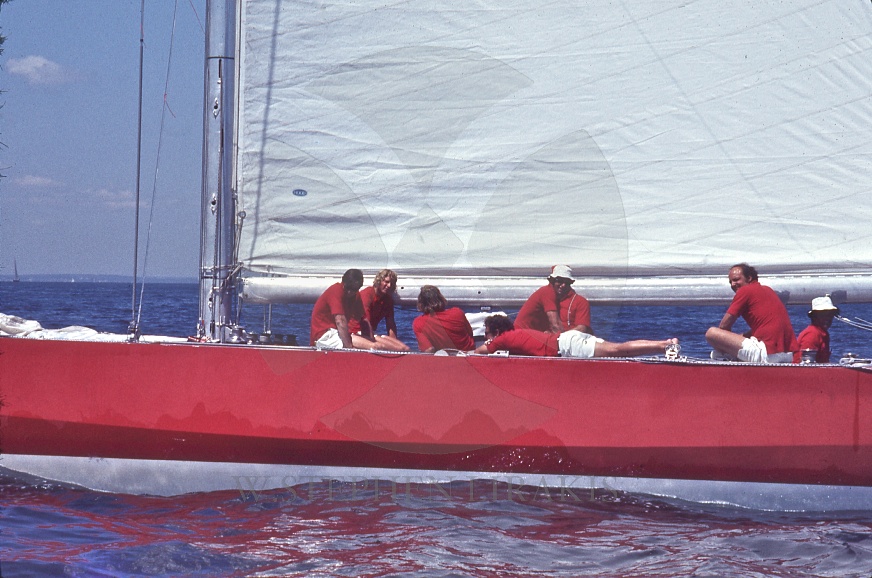
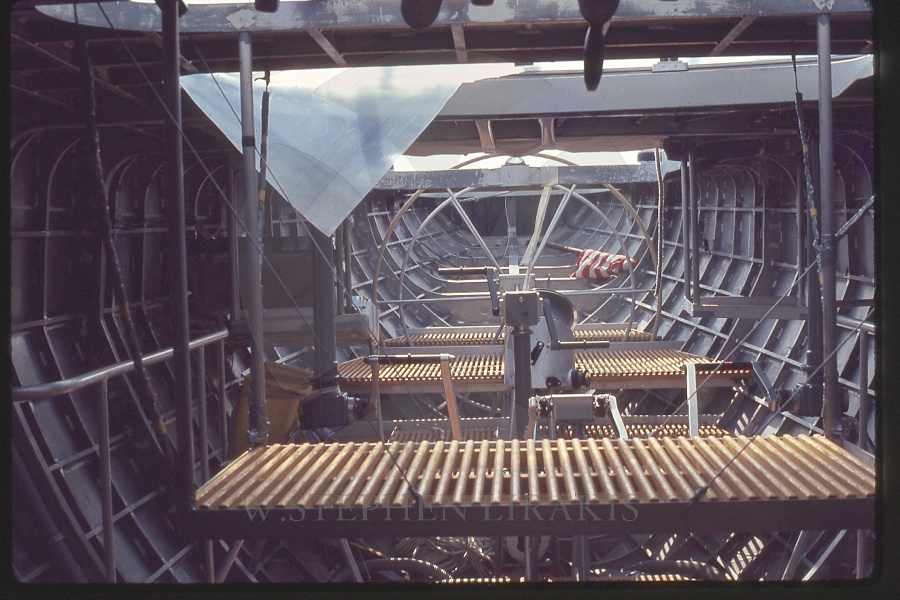
Our paths crossed many times over the years. The obvious omission here is the disastrous design of the 12 meter “Mariner”. The second aluminum 12 meter ever built. I was working at Minneford’s lofting and building “Courageous”. A group of us drove in the evenings to Stevens Institute to take a course instructed by Peter Desaix. Peter was responsible for the analysis of the results of towing models in the tank. He would start each class rubbing his hands with glee stating that Britt had achieved a breakthrough. It turned out to be a huge mistake; on the part of an error of interpretation of the tank results. This almost finished Britt Chance’s career. Looking back, not his fault. The data led him down the wrong path.
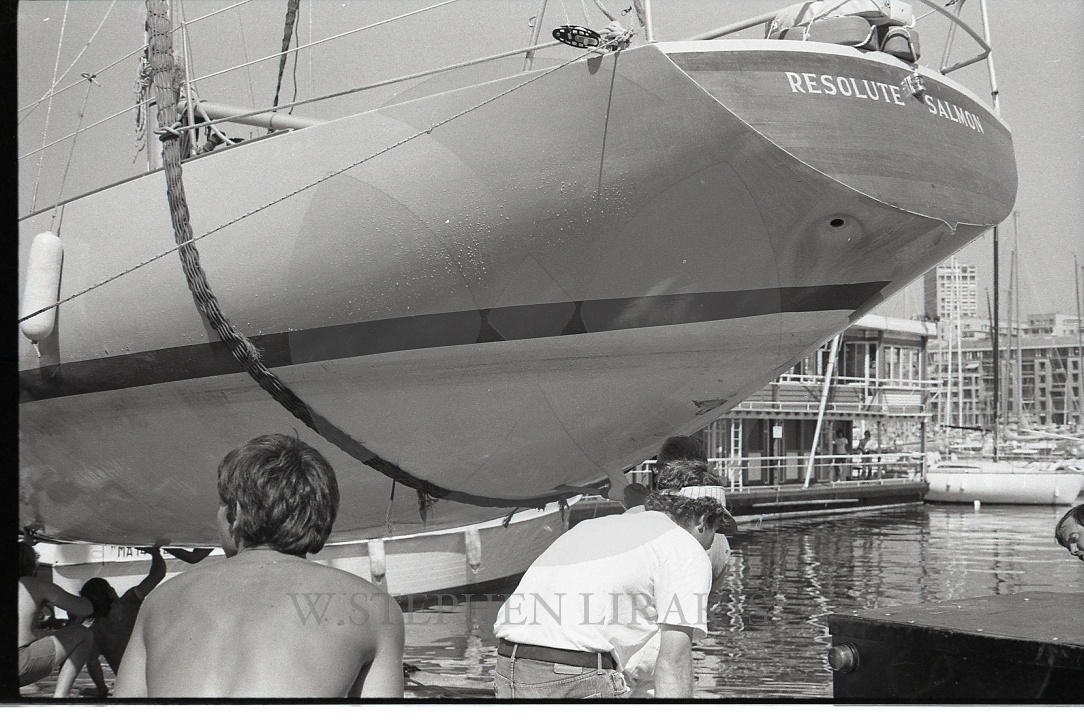
“Resolute Salmon” winning the one ton world championship in 1976 held in Marseille, France. In my mind resurrected Britt’s career.
EIGHT BELLS – BRITTON CHANCE, JR.
Britton Chance Jr., lead designer for the successful 1987 and 1988 Stars &
Stripes America’s Cup campaigns, died October 12 at the age of 72 years.
Britt Chance grew up around boats – both sail and power – became seriously
interested in yacht design at 15, trained in the sciences at the University
of Rochester, worked at the towing tank at Stevens Institute, studied
mathematics at Columbia University, worked for Ray Hunt and Ted Hood, and
went on his own with Chance & Company in 1962.
Britt has a diverse design portfolio which ranges from racing shells to
dinghies to multihulls, fast cruisers and offshore racers to power boats,
including the high-tech Flarecraft, as well as Meter and America’s Cup
boats. Indeed, Chance is closely identified with Cup design; Britt was a
lead designer in both the ’87 & ’88 Stars & Stripes campaigns, played a
leading role in the formulation of the IACC Class, and, in the ’92 Defense,
led the joint PACT/Boeing appendage research project for all US Syndicates.
An active rower and sailor, with extensive dinghy, IOR, IMS and 5.5 & 12
Meter experience, Britt was alternate helmsman in the Olympics for the 5.5
Meter and Dragon Classes. He has crewed, or skippered, in major events
including the America’s Cup Trials, One Ton Cup, Admiral’s Cup, 5.5 Meter
Worlds, and offshore in the Bermuda, Fastnet, Middle Sea, and SORC Races.
For a change of pace, he rows competitively.
The Barnegat Bay Sailing Hall of Fame inducted Britt on October 6, 2012 as
one of eight inductees who have distinguished themselves in the sport.


Comments (0)
Printable Version
Email This
Font