
This week before the start of the America’s Cup is a youth challenge of 10 teams sailing the AC 45’s.
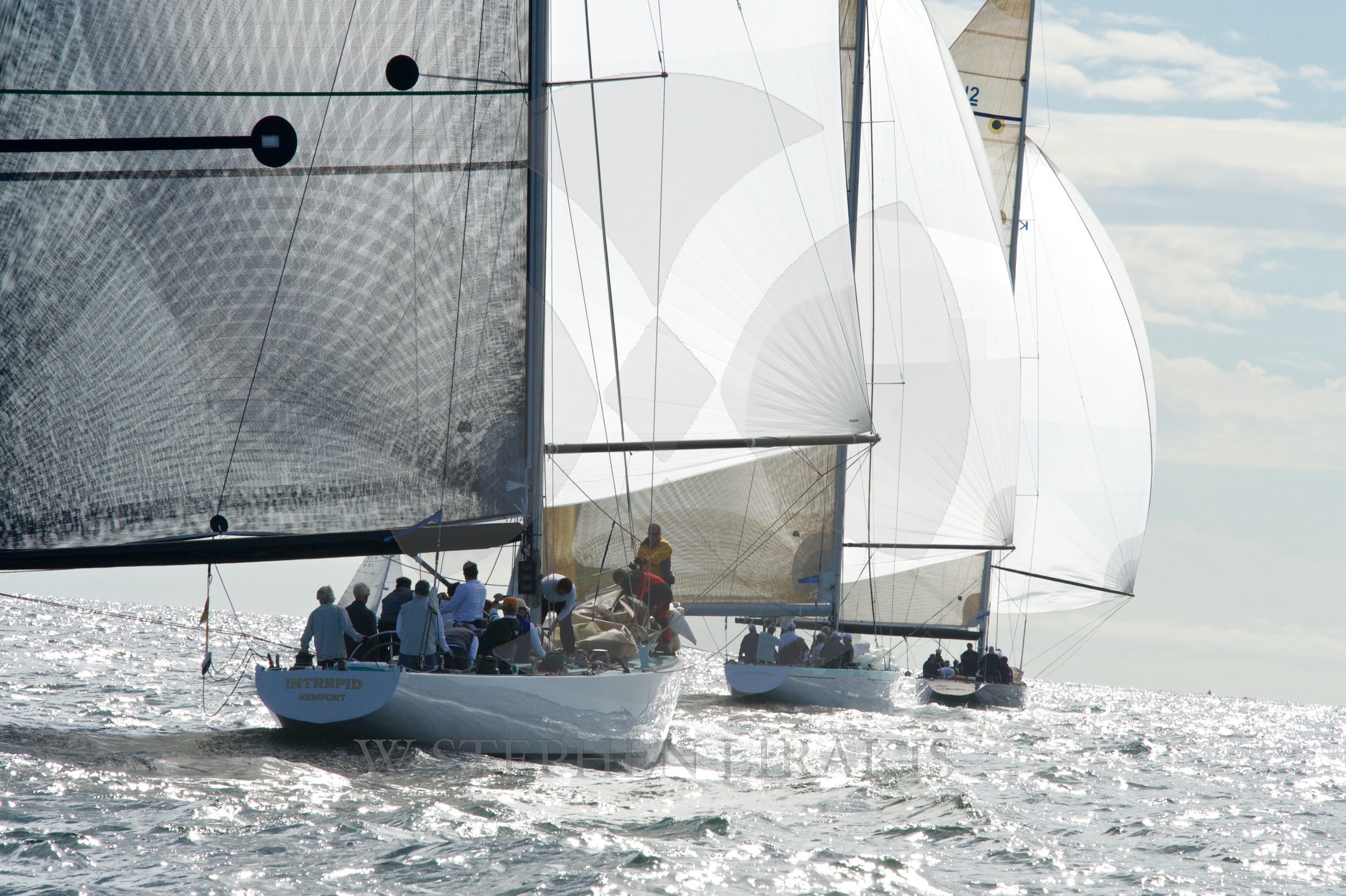
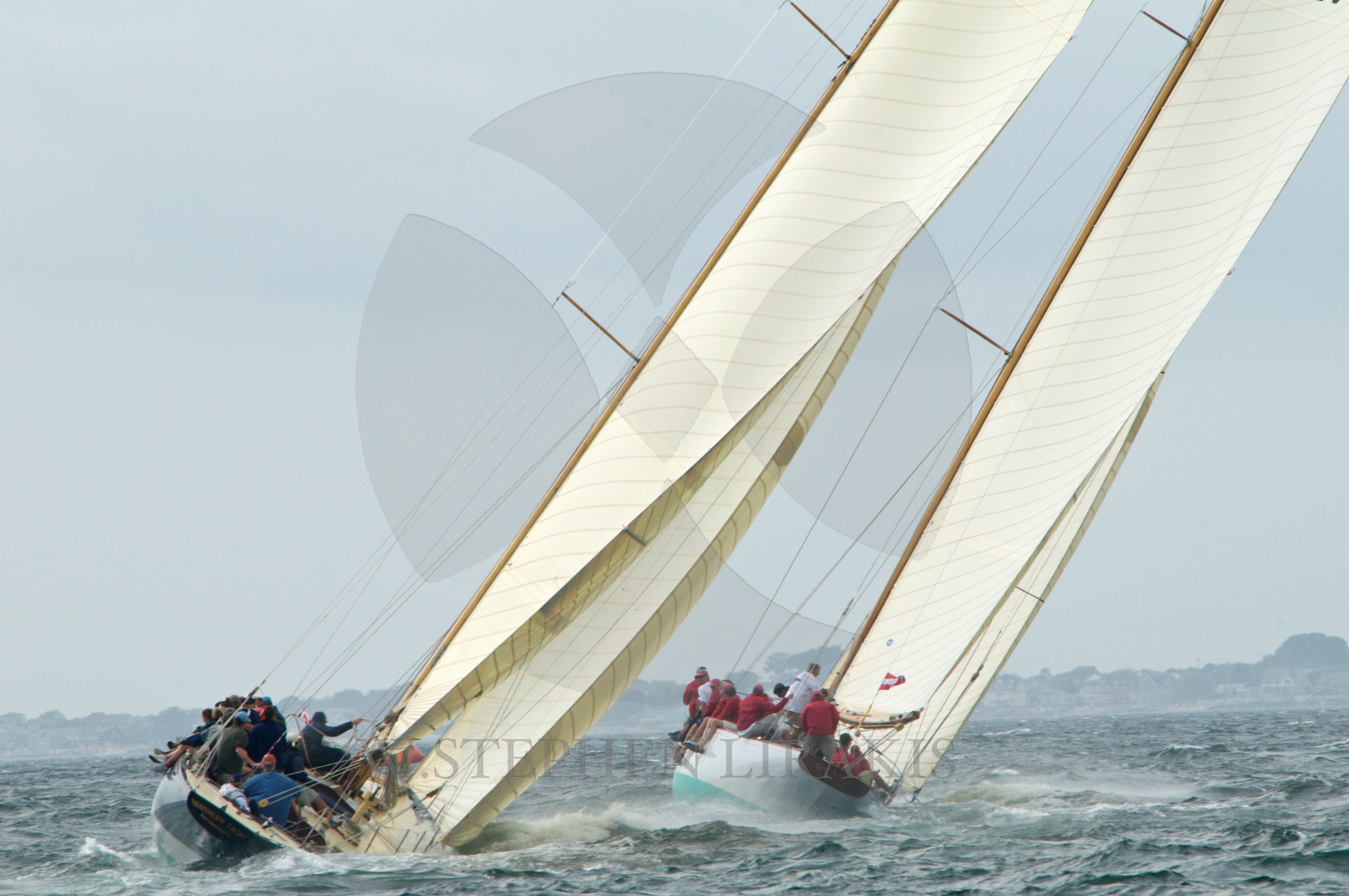
This Labor day weekend is the Classic Yacht Regatta in Newport RI.
This week before the start of the America’s Cup is a youth challenge of 10 teams sailing the AC 45’s.
This Labor day weekend is the Classic Yacht Regatta in Newport RI.
JURY CASE AC33 JURY NOTICE JN113
Protocol Article 60 and Oracle Team USA
Protecting the Reputation of the America’s Cup FURTHER DIRECTIONS
DIRECTIONS AS TO HEARING (JURY NOTICE JN102)
1. 2.
3.
On 19th August 2013 the Jury issued Jury Notice JN102.
Jury Notice JN102 stated that on 4th August 2013 the Jury received a report from Richard Slater of Oracle Team USA (OTUSA). Jury Case AC30 followed.
Jury Notice JN102 also stated that the Jury has made an enquiry and two members of the Jury carried out an investigation over the period 13th – 16th August 2013 interviewing 16 members of OTUSA and five employees of America’s Cup Race Management.
HEARING
FURTHER REPORT FROM THE MEASUREMENT COMMITTEE (JURY NOTICE JN112)
6. On 24th August 2013 the Jury issued Jury Notice JN112 attaching a further report from the Measurement Committee. The report referred to the different length of king posts and the depth of engagement of the spigot of the upper main king post fittings on OTUSA AC45 Yachts, boats 4 and 5. The conduct or activity referred to in such report, including racing with such modified equipment will now be a
28th August 2013
part of and included in the hearing to determine if the Competitor OTUSA has breached Article 60.1 of the Protocol.
7. Jury Notice JN112 also included directions that ACEA was required to provide a written submission by 12h00 PDT on 28th August 2013 as to what they consider is the effect of the conduct or activity referred to with reference to Protocol Article 60.1 on ‘the best interests of the America’s Cup, or the sport of sailing’. ACEA filed a submission on 28th August 2013.
INFORMAL DIRECTIONS HEARING
8. An informal directions hearing took place on 28th August 2013 concerning the timing and procedural aspects of the hearing which OTUSA wished to discuss. OTUSA’s Counsel Phil Bowman and Thomas F. Ehman Jr were present.
NEW HEARING DATE
9. To enable the Jury to provide a written Decision following the hearing under Racing Rules of Sailing America’s Cup Edition (RRSAC) Rule 69 in Jury Case AC31, which Decision OTUSA wish to consider before proceeding with the hearing of this Case, the date of hearing is changed to 30th August 2013 commencing at 11h00 at the ACEA Meeting room, Pier 23. It is anticipated the hearing will be completed that day.
COURT REPORTER TRANSCRIPT AND JURY CASE AC31 DECISION
10. The court reporter uncertified rough draft transcript of all of the proceedings to date in Jury Case AC31 and the Decision in AC31 will be made available on a confidential basis to OTUSA, ACEA, ACRM and ETNZ. The parties to Case AC31 have agreed that such transcript be included in this Case and OTUSA have agreed it form a part of the evidence and record in this Case.
ORDERS
CASE AC31 Hearing Transcript
11.1 The court reporter uncertified rough draft transcript of the proceedings in Jury Case AC31 is ordered to remain confidential until further order.
Appearance of Witnesses
11.2 The following witnesses are ordered to be available to give evidence:
Nick Nicholson (Chairman Measurement Committee) Russell Coutts (OTUSA CEO)
Grant Simmer (OTUSA General Manger)
Jimmy Spithill (OTUSA Skipper)
Mark Turner (OTUSA Shore Team Manager) Richard Slater (OTUSA Rules Advisor) Andrew Henderson (Rig Team Manager)
Parties and the Jury are entitled to call other witnesses at the hearing.
David Tillett
JURY: David Tillett (Chairman), John Doerr, Josje Hofland, Graham McKenzie, Bryan Willis.
America’s Cup: What you may not know about the AC72
By John Longley, 1983 America’s Cup winner
After spending a week in San Francisco and having the opportunity to talk to a number of people who have actually sailed the extraordinary AC72s, I have gathered a bit of AC72 trivia to share…
* If you had an engine to power the hydraulics rather than grinders, you could sail the AC72s with 4 people rather than the crew of 11 they now sail with.
* There is really only one trimmer on board and he controls the wing. The helmsman controls the cant and rake of the board with buttons on a control pad in front of him but only has 3 seconds of stored power before he has to “throw bananas” into the grinding pit i.e. ask for more hydraulic power.
* They have seen 47 knots as the top speed so far but expect to see the 50 knot barrier broken in the Cup match.
* The boats go directly downwind 1.8 times faster than the wind. So if you let a balloon go as you went around the top mark you would easily beat it to the bottom mark.
* There is only 4 degrees difference to the apparent wind from going on the wind to running as deep as you can.
* If you lost the hydraulics while the boats were foiling they would be completely uncontrollable and would most likely capsize.
* It is faster to find the strongest adverse current going downwind because the stronger apparent that is then generated translates into more speed than if you were sailing in slack water. (Warning – this takes a bit to get your head around)
* When sailing downwind you look for the puffs in front of you not behind you.
* It is actually quite dry on the boats, unless you make a mistake and come off the foils, as you are flying a couple of metres above the water. Waves have almost no impact on the boat when foiling.
* In strong wind you carry negative camber at the top of the wing to “reef” or de-power the wing.
* All crew carry personal tackle so they can effectively rappel down the netting if the boat capsizes.
* Gennakers are only used below about 8 knots; the jibs only provide about 3% of the lift up wind.
* The foil on the rudder generates about 800 kg of lift with the rest coming from the center board foil to lift the 7 ton yachts clear of the water.
* The centre board foil’s tip comes out of the water so it effectively works like a governor on an engine i.e. as the board generates too much vertical lift it comes out of the water, the area is thus reduced so it goes back down etc until it finds equilibrium.


The win by team new zealand was pretty much a foregone conclusion, I am reluctant to say it but I am not certain what the Italians expected or if they came for the party. I hope they got what they wanted given the price of admission.
Team New Zealand is, I believe, favored to win the America’s Cup. It will be certainly closer than the Louis Vuitton.
Team New Zealand wins the Louis Vuitton Finals 7 to 1; and will meet Oracle September 7 for the best of 17 series.
There was never really any doubt of the outcome; with the exception of breakdowns. The New Zealand team was higher and faster upwind and lower and faster downwind; causing them to jibe fewer times.
See you in September.

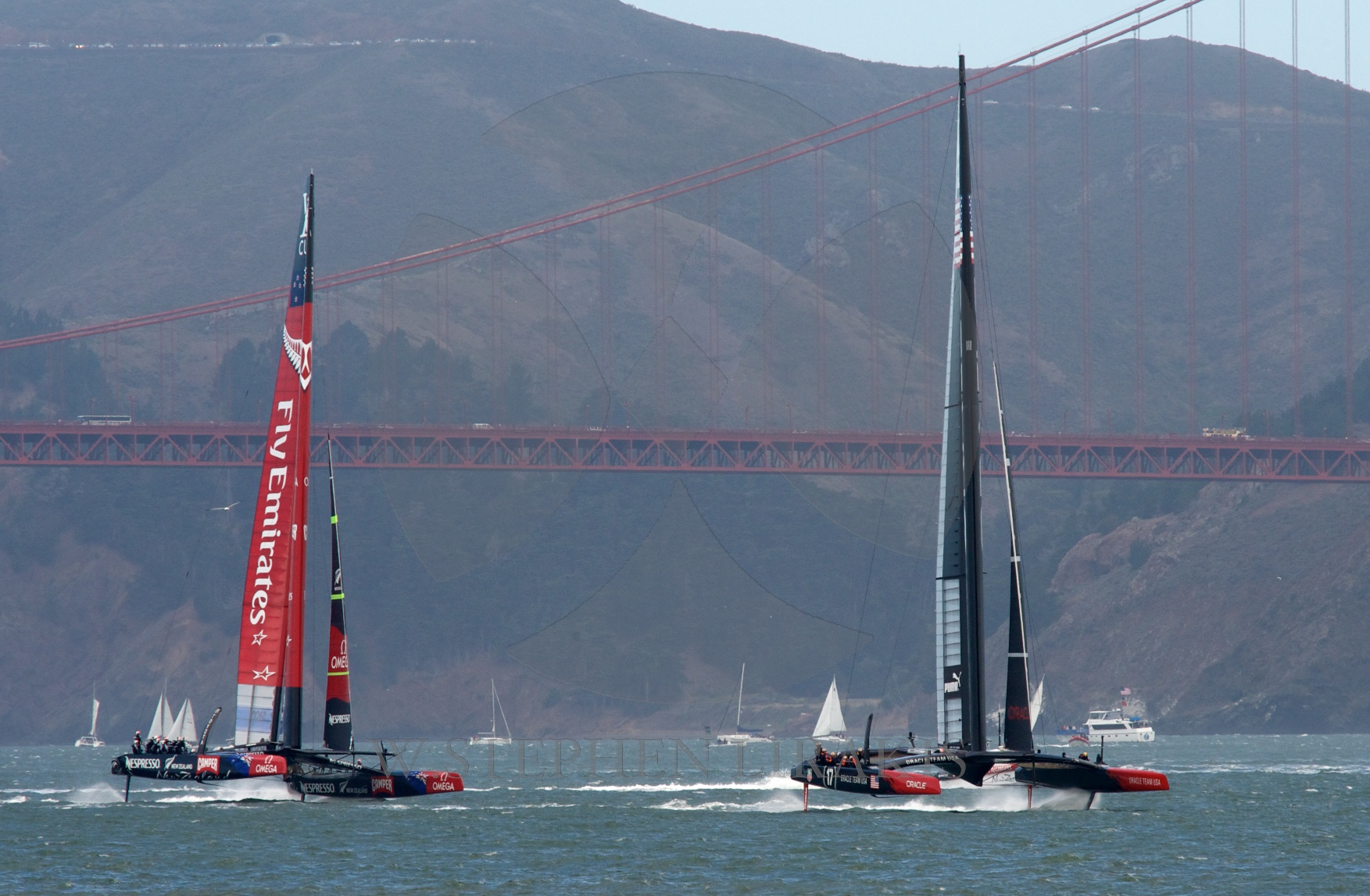
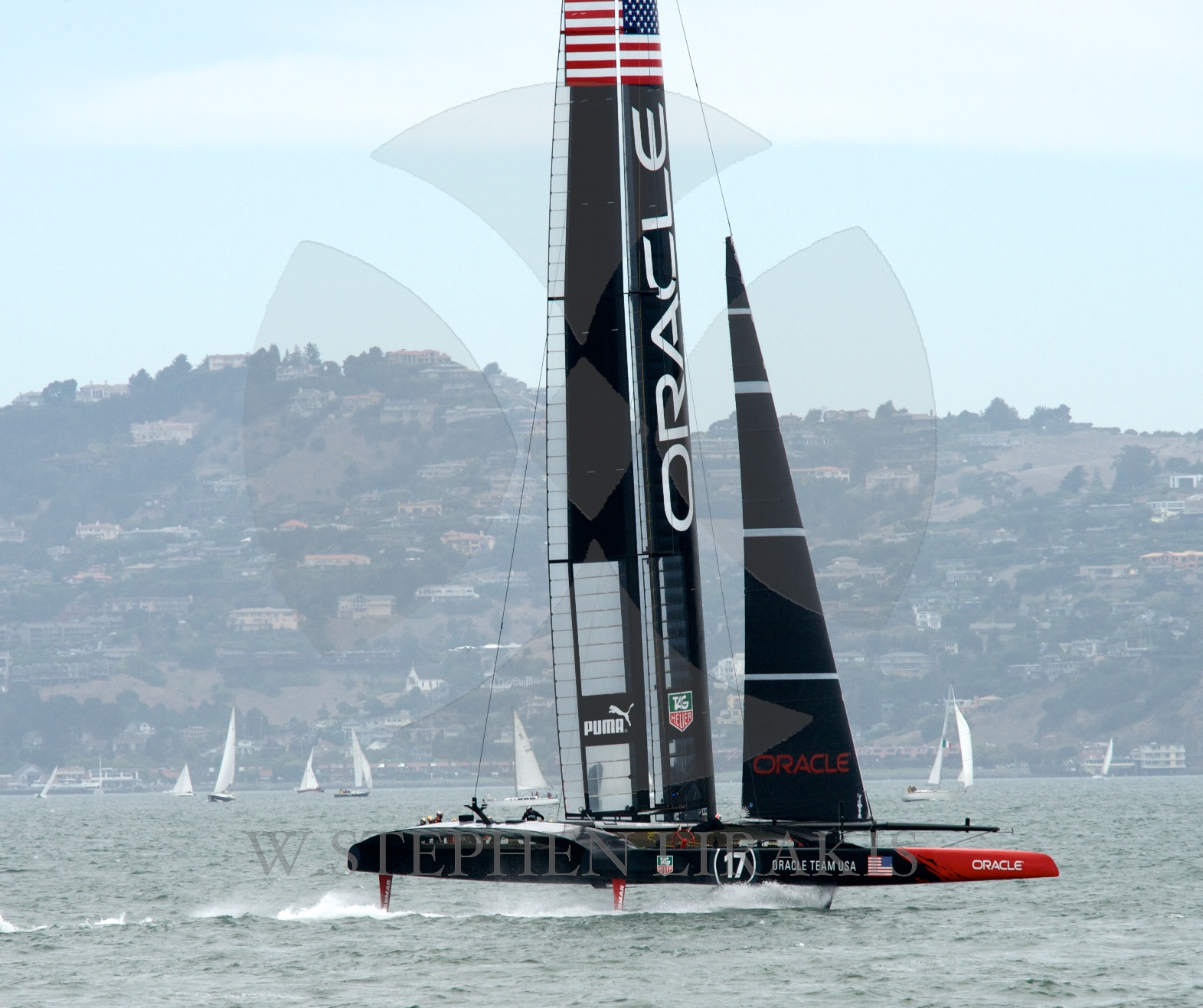
The giant wing sail boats of today’s America’s Cup were never even imagined when Howard Chapelle wrote his book “The Search for Speed Under Sail” in 1967. Twelve Meters and their ability to sail close to the wind were considered the apogee of yacht design. Twelve Meters sail 8 knots upwind and 8 knots downwind, no matter the wind strength. In those days the 12’s sailed a modified olympic triangle. Only one race a day because it took 3-4 hours to complete the race, sailed in an area as free of current as was practical; in an effort to make the race as fair as possible.
All of this has changed in today’s world. 40 minute races in an area with strong current, sailing at 40 knots. Regardless of your opinions about which is better; there is no turning back from the thrill of foiling.
The magic number is 7. Whichever team reaches that number first earns the right to challenge Oracle for the America’s Cup beginning September 7.
New Zealand won both races more importantly by completeing both race courses.
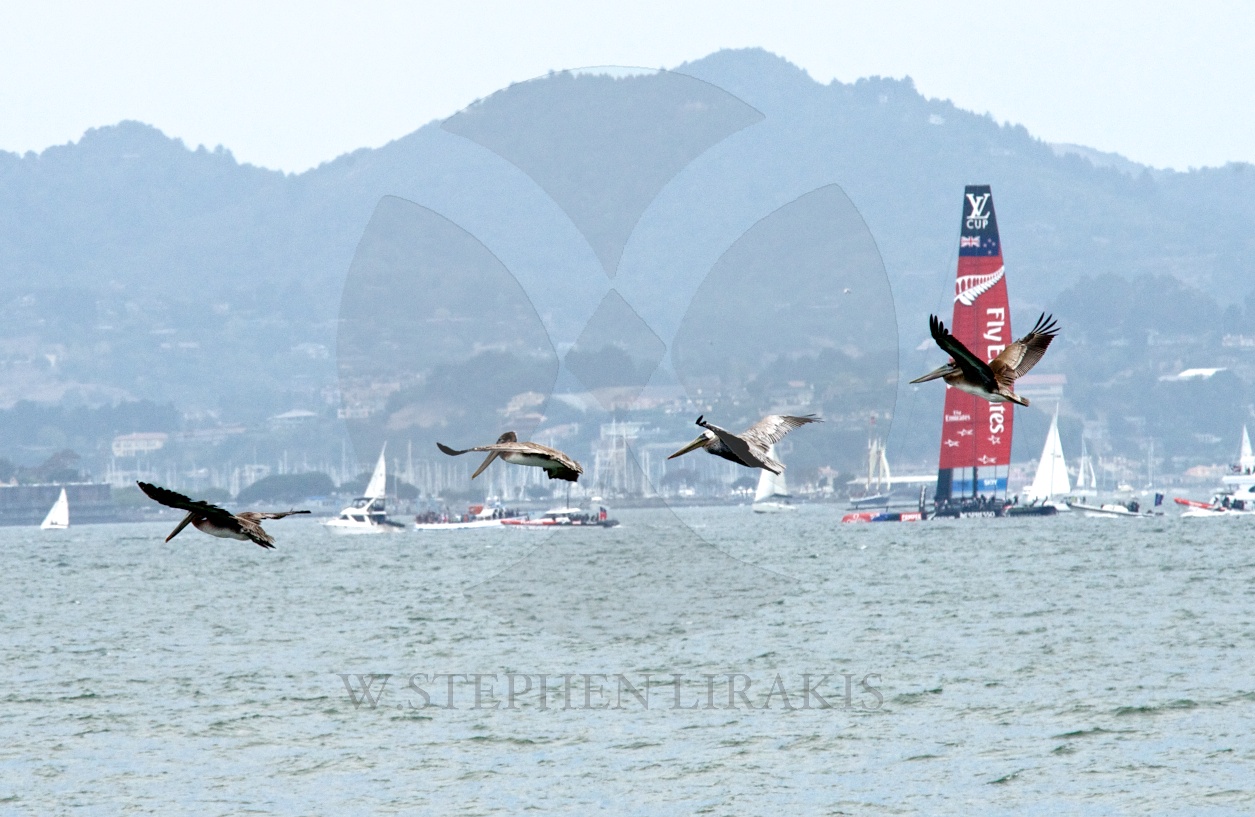
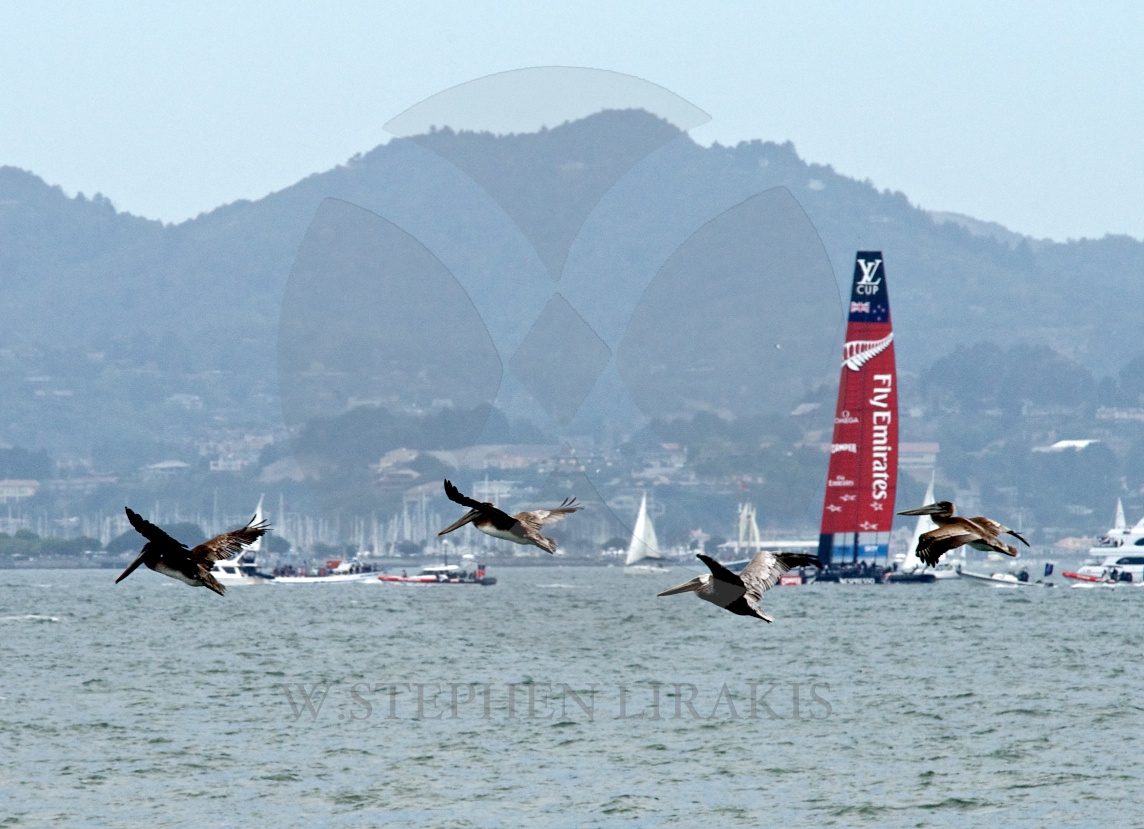
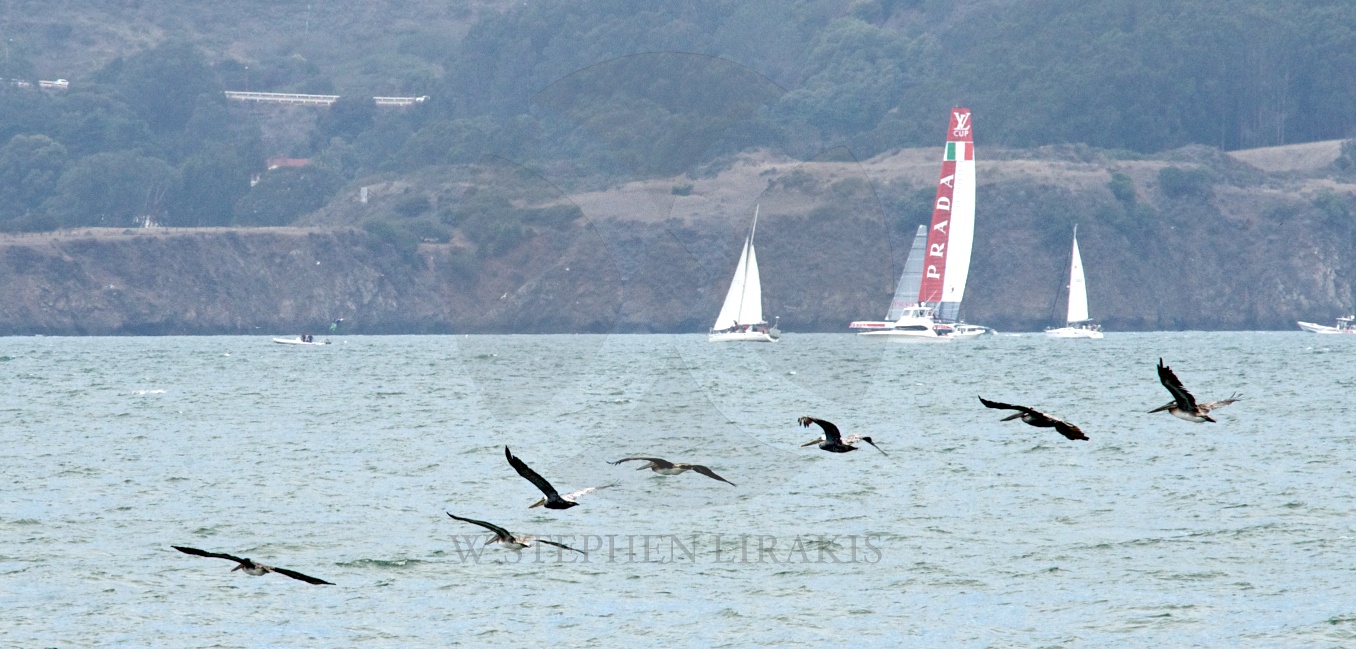
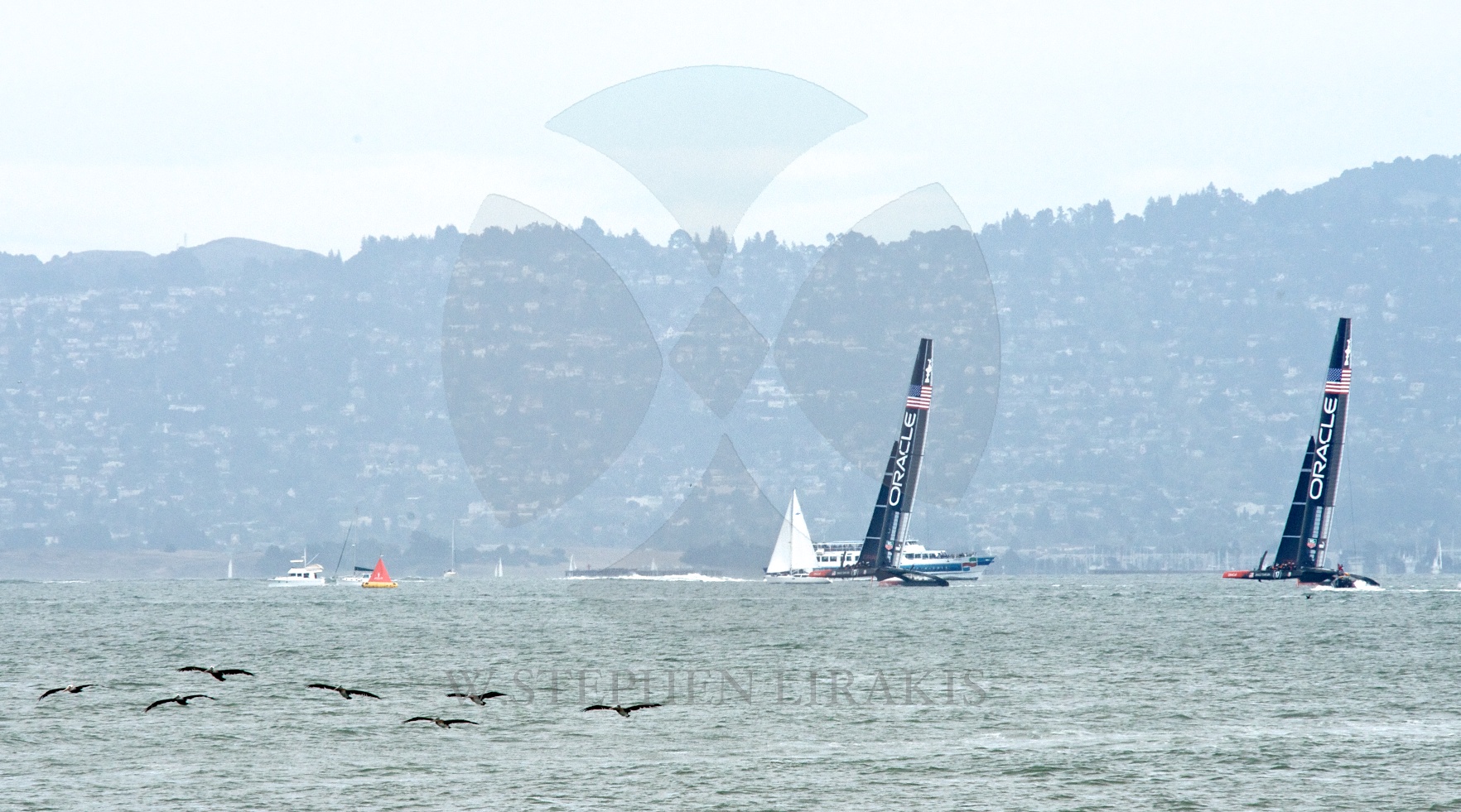

Pelican are at the same time so graceful and so odd. Should something shaped like that really be able to fly? Yet they fly quite well, powerfully and easily. looking especially curious when they dive. Perhaps not so different from the AC boats.