PIRATES AND NEW RULES

The electronic monitoring of the boats racing in the America’s Cup instead of judges in boats will changes yacht racing again. The America’s Cup seems determined to alter yacht racing as we have known it. Personally I have long wondered when we would have this sort of thing. GPS has become very accurate. Judges and the boats necessary have made match racing very labor intensive and expensive. We should be using this technology in all yacht racing. It would allow very accurate guidance in a protest hearing at the least.

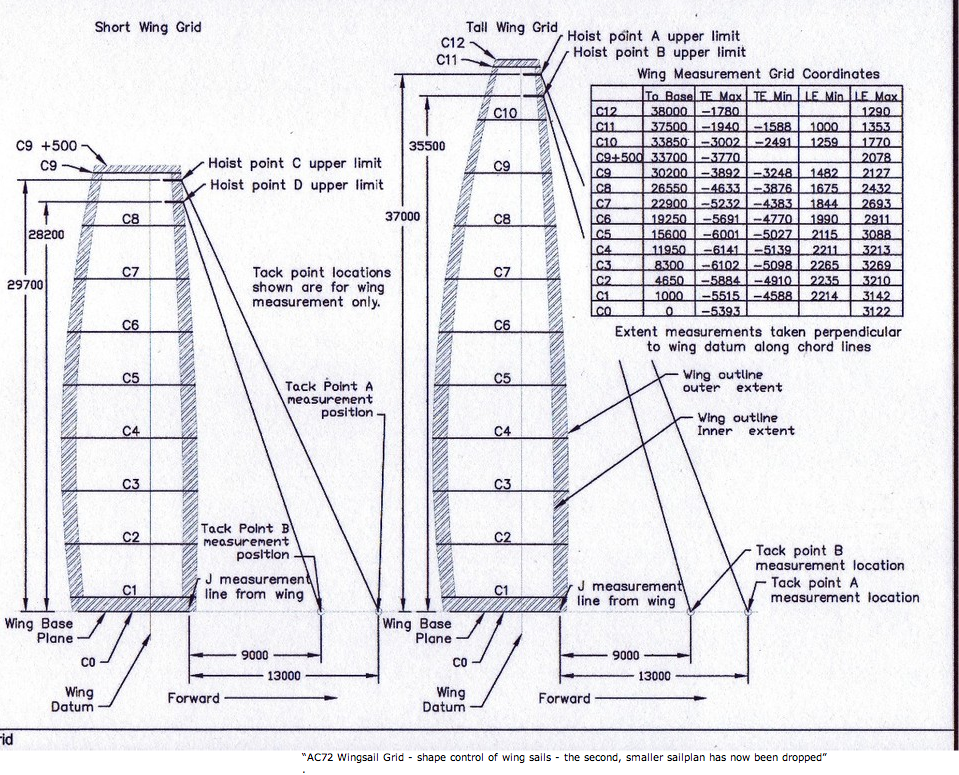
It has also been announced that the solid wings for the 72 foot boats will be only the smaller version, not several as originally planned.
This is the light side of sailing. Four Americans were killed this week in a part of the world that has become famous for Pirates.

Even for modern Navy, no easy solution to piracy

BY JEANETTE STEELE

WEDNESDAY, FEBRUARY 23, 2011 AT 9:38 P.M.

pastedGraphic.pdf

/ USS STERETT

The 509-foot Sterett steams off Point Loma during maneuvers in 2010. The destroyer is among the Navy’s newest ships, having been commissioned in 2008.

In the vast waters around the Gulf of Aden, roughly 1 million square miles of sea, finding pirates and rescuing their victims is something even today’s sophisticated, nuclear-power Navy can’t always do.

After Tuesday’s killing of four Americans aboard their hijacked yacht off the coast of Oman, Navy officials remained silent about whether the American deaths will prompt a change in tactics. Meanwhile piracy experts say bulking up the U.S. military presence or even attacking pirate dens in Somalia isn’t necessarily the long-term answer. Any solution must change what turns people into high-seas criminals, they said.

Navy ships steaming out San Diego, including the Boxer amphibious group on Tuesday, are increasingly listing anti-piracy as one of their top deployment missions. But they are finding themselves operating in a part of the world where the brigands are not ideology-driven terrorists or warriors, but desperate youths being controlled by businessmen hungry for multimillion-dollar ransoms.

“Everybody’s going to say now we’ve got to go in there guns blazing,” said retired Rear Adm. Terry McKnight, who commanded the Navy’s anti-piracy task force when it was launched in early 2009.

“But, first of all, nobody wants to go after the pirates ashore in Somalia. And the other thing is, it’s a criminal event. You have to fall under the guidelines of international justice,” McKnight said.

“If we had a 1,000 ship Navy to go out there, we’d make a major dent in piracy … but the problem is the area is so vast you can’t be everywhere.”

Last year was the worst on record for mayhem on the seas. Pirates captured 1,181 mariners and killed eight, hijacking more than 50 ships, according to the International Chamber of Commerce’s International Maritime Bureau.

The situation is most bleak off Somalia, which accounted for 92 percent of all ship seizures in 2010.

International attention, including the Navy’s now 2-year-old Combined Task Force 151 and two European task forces, has decreased attacks in the Gulf of Aden. Navy officials said there are 34 warships, under 15 different national flags, now patrolling the gulf area.

But the pirates are pushing farther out.

Tuesday’s killings were an example of the new pattern: Somali pirates used a “mother ship,” a larger vessel they’d hijacked earlier, as a base to extend their skiff attacks northward into the Arabian Sea.

The 58-foot yacht, carrying a Marina del Rey couple and their two friends, was trailed by four Navy ships, including the San Diego-based destroyer Sterett.

Negotiation with the pirates was attempted but ultimately failed to save the Americans, who were killed by the pirates. A team of Navy SEALs raced to cover the 600 yards between the Sterett and the yacht after pirates fired a rocket-propelled grenade at the destroyer.

To Tom Wilkerson, U.S. Naval Institute chief executive, that loss of life means current anti-piracy strategy isn’t working.

Differing from McKnight, he is in the camp that says follow the pirates onto land.

“Finding pirates in the act in that area is a dice roll,” said Wilkerson, a retired two-star Marine general.

“If the U.S. and the international community are serious about reducing the piracy, they need to engage using the UN resolutions to put some kind of force ashore and remove the sanctuary.”

The Sterett is only the most recent in a string of San Diego warships drawn into pirate-fighting.

In September, a platoon of Camp Pendleton-based Marines aboard the Dubuque rescued the crew of the German cargo ship Magellan Star.

In a mission that required a White House green light, 24 force reconnaissance Marines captured 9 Somali pirates and saved the crew that was hiding in a fortified part of the ship.

Capt. Alex Martin, who led that team, said the Somalis almost instantly dropped their earlier bravado when the first Marine appeared over the bow.

“You felt like they were criminals who had been caught. It wasn’t like dealing with elements of al Qaeda in Iraq, where this is what these guys do, they believe in this,” said Martin, 28, a La Jolla High School graduate. “These were just criminals. And once they got caught, they were like, ‘Oh, God, what now?'”

The San Diego-based destroyer Howard had its pirate encounter in September 2008, when it rushed across 350 miles of ocean to aide the Faina, a Ukrainian vessel carrying military weapons.

In the end, the ship’s owners declined to risk their cargo in a raid, instead paying the pirates a $3 million ransom six months later.

And, in one of the most high-profile actions of late, Navy SEAL snipers bobbing on the back of a destroyer shot pirates holding the captain of the American cargo ship Maersk Alabama at gunpoint in April, 2009.

It was that incident, and the later 33-year sentence handed to one of the pirates by a New York court, that may have intensified the peril on the seas.

The Associated Press on Wednesday quoted Somali marauders who vowed that they will kill hostages before being captured during military raids and facing trial.

It’s not the way this business used to work, piracy experts say.

Somali pirates were known for taking hostages and holding them, alive, for ransoms that have ballooned in recent years. A common demand in 2005 was $150,000 to $200,000. Now the stakes have risen to as high as $9 million per ship, said Martin Murphy, author of the new book “Somalia, the New Barbary? Piracy and Islam in the Horn of Africa.”

If the international community promoted some other way for ordinary people to make money, that pirate bounty might not look so attractive, Murphy said, as much of it flows to the ringleaders, not the people taking the risks.

For cargo shippers, the high-stakes gamble appears to make sense for now, said Peter Chalk, RAND Corp. analyst. Using the Suez Canal and the Gulf of Aden cuts travel time from the Mediterranean Sea to the Indian Ocean by three weeks, saving the shipping industry an estimated $2 billion a year or more.

Efforts to make ransom payments illegal have gone nowhere, Chalk said. If the United States wanted to change that, or rewrite current rules of engagement for Navy ships fighting pirates, the task would be difficult because these maritime polices are international in nature, he said.

Pleasure boaters used to be somewhat safe from Somali pirates, as they weren’t seen as rich ransom targets. That may explain why the Marina del Rey couple entered the area off Oman.

“I think here they weren’t expecting trouble because they were so far away from major concentration of attacks,” Chalk said.

As Wilkerson, the retired Marine general, said about U.S. policy toward pirates, that strategy may need to be reworked in the future.


DATES FOR THE AMERICA’S CUP WORLD SERIES

The winning America’s cup trimaran USA 17 belonging to Oracle racing is transiting the Panama Canal as I write on it’s way to San Francisco.

America’s Cup World Series Dates Released
With final venue bids under review, the America’s Cup Event Authority (ACEA) released the inaugural America’s Cup World Series (AC World Series) dates. The first half of the AC World Series will consist of five nine-day regattas in 2011, finishing up with three more regattas by mid-2012. The winning host cities for the 2011-2012 AC World Series will be revealed in the coming weeks.

The AC World Series venue assessment process has focused on the ability of prospective host sites to provide the infrastructure and support needed to stage a superior event on and off the water. Tens of thousands of fans are expected to watch in person at each venue.

The 2011-2012 AC World Series will be sailed in the AC45, the forerunner to the next generation of America’s Cup boats.

The 2012-2013 season will be sailed in the larger and faster America’s Cup boats, the AC72, and its champion will be crowned just prior to the start of the Louis Vuitton Cup (America’s Cup Challenger Series) in July 2013. This AC World Series will also enable all teams seeking to compete in the America’s Cup Finals in September 2013 to be race-ready for the AC72.

2011-2012 America’s Cup World Series Schedule*

Event One: 16 – 24 July
Event Two: 13 – 21 August
Event Three: 17 – 25 September
Event Four: 15 – 23 October
Event Five: 10 – 18 December
Event Six: 17 – 25 February, 2012
Event Seven: 14 – 22 April, 2012
Event Eight: 19 – 27 May, 2012

*Dates are subject to change

WHO IS PAYING FOR THE AMERICA’S CUP?

Footing the bill for the America’s Cup still an issue

Comments (0)

pastedGraphic.pdfScrounging up cash: The America’s Cup Organizing Committee and the America’s Cup Event Authority are tasked with raising a total of $300 million for the yacht race. (Getty Images file photo)

On the America’s Cup to-do list for the next two years: Make plans and review the heck out of them. Demolish some buildings, build others. Design and erect yachts, then race them. Attract hundreds of thousands of people and then entertain them. And what else?

Oh yeah — pay for it all.

Two entities — the America’s Cup Organizing Committee and the America’s Cup Event Authority — are tasked with raising a total of $300 million.

Six weeks after San Francisco was chosen to host the 2013 race, neither has yet raised a dime — mostly because they have been trying to hammer out who is responsible for raising what — a question that, until Friday, elicited different answers from each agency at this point.

On Friday, the leaders of both entities sent in a statement saying they consider “the entire 300M a shared responsibility” and that ever since The City won its bid to host the event “we have worked jointly to raise this money and are aligned in our fundraising efforts.”

But just the day before, Mark Buell, the chairman of the ACOC, a nonprofit volunteer board made up of mostly local business and government leaders, said his organization needs to raise about 10 percent of the $300 million total. That $32 million raised by ACOC will cover the city of San Francisco’s costs, which will come in the form of police security, transportation and environmental review. The rest would mostly be left up to the for-profit Event Authority, mostly through sponsorship contracts and TV rights.

At the time, Craig Thompson, CEO of the Event Authority, contradicted Buell and said the ACOC is contractually obligated to raise all $300 million, and the Event Authority is simply helping them.

“If you look at the contract, San Francisco’s Organizing Committee has an obligation to deliver $270 million to the event, plus the $32 million to offset city costs. …. We’re the ones who get big companies to understand why they should put their money into this — it’s a good investment for them,” Thompson said.

But in an e-mail the following day, Thompson changed his tune: “Since San Francisco won the right to be the host city for the 34th America’s Cup, we have worked jointly to raise this money, and are aligned in our fundraising efforts.”

Asked how confident he is that the ACOC will be able to raise the money for the event, Buell laughed.

“I don’t sleep at night, thanks for asking,” he joked. “Really, I do wake up at 2 in the morning, trying to figure out if we can really do it.”

The first sign that the America’s Cup is coming to town could be apparent as soon as next month, when the massive trimaran that won the last Cup is displayed on The City’s waterfront.

The massive racing yacht is currently being shipped from Spain to San Francisco. Its mast is so tall that it can’t fit under the Golden Gate Bridge, so it has been taken off the ship and will be reassembled once it arrives.

Last week, Mayor Ed Lee said it’s yet to be determined where the yacht will be displayed, but he said it is expected to play a part in the fundraising drive for the event.

Sponsorship will bring in the bucks

Those who can afford to cough up millions of dollars for America’s Cup sponsorship will be able to watch the event at close range: from the boat itself.

The America’s Cup Event Authority, a for-profit entity billionaire boat racer Larry Ellison created to put on the event, has set up three tiers of sponsorship: a global partner, a global sponsor and a national sponsor. Each tier will accommodate just six sponsors, and will guarantee different levels of advertising and branding.

Event Authority CEO Craig Thompson wouldn’t say how much the tiers cost, but said that an independent media valuation firm pegged the value of the top sponsorship at $74 million — but the authority will discount that cost significantly.

Companies that fork over for that highest tier will have their names branded on the buoys around which the yachts will turn. They also secure TV sponsorship, room at the VIP sponsorship tent — and one lucky person will be strapped onto the boat during the race, he said.

kworth@sfexaminer.com

THE SAN FRANCISCO WATERFRONT

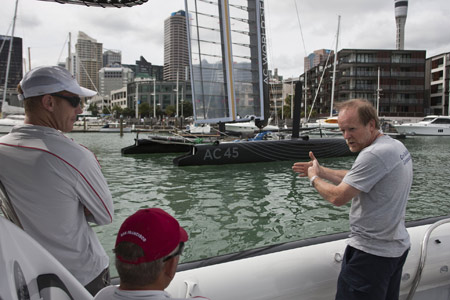
San Francisco is still adjusting to the idea of hosting the next America’s Cup. There is much to be accomplished. There is a lot being done behind the scene presently. I have included a photo of the waterfront which shows just how close the docks awarded to Larry Ellison are to the city; walking distance to almost everything, including the financial district. Below is a photograph showing the waterfront where the Oracle team will make it’s camp.

YACHT CLUB DE FRANCE 6TH CHALLENGER FOR THE AMERICA’S CUP

Energy Team unveiled

The Peyron brothers at the sixth official challenger for the 34th America’s Cup

Wednesday February 9th 2011, Author: James Boyd, Location: France

Energy Team has officially become a Challenger for the 34th America’s Cup. Launched and run by Loïck and Bruno Peyron, this challenge is backed by the Yacht Club de France. The construction of the first AC72 multihull will begin at the Multiplast yard in Vannes on 1 September.

Within the news last September that the 34th America’s Cup would be raced in multihulls, the Peyron brothers two of the oldest exponents of this discipline announced that they wanted to bring French know-how together and so set up their own challenge to win the prestigious trophy.

So Energy Team, is the Peyron’s new French challenge and has been officially registered for the 34th America’s Cup since 27 January 2011. It is the sixth Challenger for the 34th America’s Cup.

Energy Team is challenging via the Yacht Club de France and aims to be one of the most competitive teams taking part in the event. The team’s ambition is to do all it can to take part in the next two America’s Cups.

Philippe Court, President of the Yacht Club de France commented: “…after attempting without success to bring together the two potential teams that have declared themselves, it seemed to us not just the normal thing to do, but a necessity that the YCF and its board support Bruno and Loick Peyron’s project to take a challenge to the Golden Gate Yacht Club by becoming Official Challenger for the 34th America’s Cup. It was normal because with the new format for the America’s Cup, Bruno and Loick’s list of achievements in multihull racing, a real French speciality, confirms their place, as well as their technical and managerial skills, making these two exceptional sailors the best candidates for a French attempt in the Cup. It is a necessity as it fits in perfectly with the mission of the YCF to take part in any attempt, where France (finally) has a serious chance of seizing victory in the America’s Cup, after taking part in every edition since 1970.”

Russell Coutts added: “It’s fantastic that we’ve got another team in the America’s Cup and what should be a very competitive one. Obviously Loïck and Bruno Peyron have a lot of multihull experience and they know how to campaign these boats and Loïck was very involved in the last America’s Cup. So I think it’s fantastic that they are in this. I know they have been wanting to get into this and it’s great to see they have lodged their entry.”

Bruno Peyron is the general manager of Energy Team while younger brother Loïck will be skipper and also be in charge of the Design Team.

To fulfil this ambition, Energy Team has signed an exclusive partnership with Multiplast, the boatyard based in Vannes who have previously built Bruno Peyron’s Orange I and II catamarans along with the present Jules Verne Trophy record holder, Franck Cammas’ Groupama 3.

While construction of the team’s first AC72 catamaran will start 1st September, her launch is scheduled for April 2012. Yann Penfornis, Managing Director of the yard, will be coordinating the AC 72 design and construction teams, under the supervision of Loïck Peyron.
The team will also be getting an AC 45, which is set to be delivered to Energy Team in March 2011, so they can begin training in Auckland.

To train and then to race, Energy Team will have at its disposal an impressive fleet of multihulls of all sizes, with 17 in all available to them: four Class A boats, four F18s, a D35, an X40, a G-Class maxi-catamaranb (the former Orange II), two AC45s and two AC72s… plus four F25s, which are a 1/3 scale model of the AC72s, which will be used for the America’s Cup.

The Energy Team base, the nerve centre of the project, will be set up on the Atlantic coast of France. It will include three centres: one in Vannes, the Multiplast yard, which will be the construction and technological development base; one in Lorient, which will be dedicated to the AC72 and G-Class catamarans; and finally one in La Baule, which will both be the main training centre for the squad and the operations centre for all the work with partners and the media.

Core members of the team
The core members of the Racing Team are already in place and bring together a wealth of experience in four major areas that are vital for performance. The core members so far appointed include the following:

Loïck Peyron, skipper of the AC45 and AC72: 6 times F60 world champion, 8 times F28 Trophy Champion winner,

Bruno Peyron: 8 times world ocean records champion, skipper of the G Class, which will be the ambassador for Energy Team,

Yann Guichard: helmsman with Loïck Peyron : Extreme 40 world number 2, Member of the French Olympic team,

Thierry Fouchier: performance team, the only Frenchman to have won the America’s Cup with BMW Oracle Racing aboard which he was the wing sail trimmer.

Jean-Christophe Mourniac: performance team, member of the French Olympic team, one of the world’s top 5 Tornado and F18 racers over the past ten years.

Yves Loday: coach for young talent. Former member of the French Olympic team, he was Tornado gold medallist in Barcelona in 1992. He will be joining the team to prepare the “Youth America’s Cup” that the American Defender is launching.

The executive committee in place

Within the executive committee of Energy Team set up around Loïck and Bruno Peyron, we can find such influential members as Philippe Court, President and Gérard Petipas, Vice-President of the Yacht Club de France, but also various personalities, whose expertise and skills can only be beneficial, from a strategic as well as a marketing, business and legal perspective. François Château, President of the Salans international law firm (in charge of the legal aspects of the project), Erik Maris, from the Messier Maris consulting agency and Thierry Reboul, President of the event management agency Ubibene, which will be taking care of the marketing strategy and partnership packages.

Key dates
• 26th October 2010 : 1st announcement made by Loïck and Bruno Peyron
• 27th January 2011 : The Yacht Club de France becomes the official Yacht Club for the ENERGY TEAM challenge
• 27th January 2011 : ENERGY TEAM, 6th official challenger
• March 2011 : Official closing date for registrations
• March 2011 : Launch of the first Energy Team AC45
• June 2011 : Start of the AC World Series
• April 2012 : Launch of the first Energy Team AC72
• 13th July to 1st September 2013 : San Francisco, Louis Vuitton Cup.
• 7th to 22nd September 2013 : San Francisco, final match

UNDER THE HOOD IN THE AMERICA’S CUP

Wingsails for the AC72: 2013 America’s Cup
Part 2 with Designer Pete Melvin

February 3, 2011

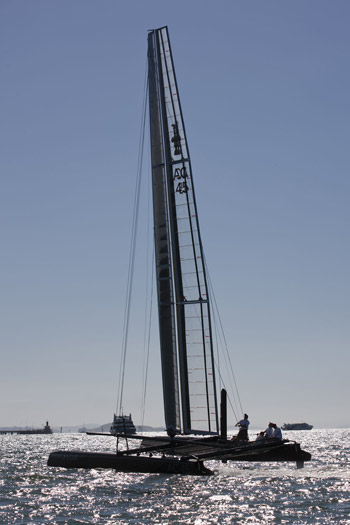
AC45 boat #1. The AC45 wing is 21.5m/70ft tall. The AC72 wing will be up to 40m/131 ft tall, about 86% larger by height and nearly double in area.
Photo:©2011 Gilles Martin-Raget/americascup.com

Pete Melvin, a co-author of the AC72 Class Rule, explains where technology development is likely to focus for the AC72, why the America’s Cup cats ended up with two wing sizes, and the role of the sailors in what looks like an increasingly computer-driven fast-tracked development environment:

The wing sail, brought forward from BMW Oracle Racing’s successful America’s Cup 33 challenge, might just be the area of greatest design advancement for the 34th defense of the America’s Cup in 2013.  There is noticeable excitement in Pete Melvin’s voice when he discusses the possibilities of a Class Rule left wide open — and left that way for a reason.

“I think the wing and the underwater foils will be two huge areas of development.  The wing needs to be a certain height and area, but how you get there, how many elements or slots or what your structure is or what your controls are, that’s up in the air.  There’s been some good development on the wing in the past, but budgets have been pretty small, so we’re hoping to see development in that area.”

What sort of advancements?

“You never know, things that work better and are simpler and less expensive….  There’s a lot of promise for wings on boats, so I think this will be one of those areas that will be a good trickle down.  We think there is some area for improvement in wing design, so we didn’t want to limit it to geometries that have been used in the past.  We looked at a rule that’s more restrictive, such as the wings that are being used in the C-Class, but it was very difficult to write a rule around a 3D object with moving parts.  Whenever we wrote a rule to limit something, we would find five ways around it.  By writing very restrictive rules, you actually increase complexity and cost, so by leaving things open, things turn out to be much simpler, elegantly efficient.

“For instance, the Oracle trimaran originally had six foils,” Melvin points out.  “It ended up with four — the center daggerboard and rudder were removed in the end.  The wing could have been any design.  But it actually ended up with a fairly simple wing, geometrically, and the appendages were as simple as you could get.  If you look at the very successful racing classes around the world, such as the Open 60, they have very few rules.  They’re a box rule and they’ve ended up very elegantly simple.  Every year, there are incremental performance gains, but the boats don’t any cost more, it’s just different geometry and configurations.  If you’re going to spend time and money on something, you might as well leave it a little bit open and let true development happen.

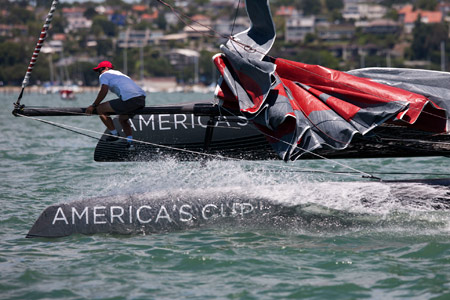
Wave-piercing bows of the AC45.
Photo:©2011 Gilles Martin-Raget/americascup.com

“The parameters of the boat we have restricted to small ranges are really the key elements:  Beam, weight, sail area, waterline length.  Those are the main restrictions.

“The hull shape can be anything you want.  You’re allowed to have two rudders and two daggerboards, but they can be any shape you want.  We’ll probably see wider variations at first, but as everyone tests designs, they’ll probably all start to look alike as we go forward, and performance will be closer.  A bigger performance difference will be the actual sailors.  These are new boats, so there will be differences in the learning curve.”

Ah, yes, sailors.  Depending upon what you read during America’s Cup 33, what with hydraulically-canted masts, thousands of data points processed per second, and real-time heads-up display of structural loads and alarms, it’s easy to believe that software was running USA-17, not a real live crew, and that computers will win the day for AC34.  But as an experienced designer of some of the most advanced multihulls in the sport, Melvin has every confidence in the ability of top sailors to figure out this new design, and he knows that sailing talent is a key ingredient in creating a fast boat in the first place, let alone winning with one.

“The best sailors, sailing either an Optimist or an AC72, the cream will always rise to the top.  Some people may not be able to get their heads around a totally different concept, but if you’re a world-class sailor and you have an open mind, there’s no reason you can’t become a world-class multihull sailor as well.

“The design teams should be able to give the sailors a very good idea of how to set the boat up and sail it initially, but like any other new boat, it will have to be developed on the water.  It’s impossible to model the real world in a computer, there are too many variables.  It will be a development process; most of the teams will be sailing similar boats as they ramp up, like the AC45s, and I would think you’ll see most of the teams sailing other multihulls, getting some smaller boats, designing and testing smaller wings for those boats, testing some concepts and tuning up the sailing team and the design team.”

If one actually reads the Class Rule (show of hands?), it is instructive to see just how much leeway Melvin and the organizers have incorporated.

“What is interesting about the rule, and the event planning, is that organizers are leaving quite a bit up in the air so they can discard concepts that don’t work and change plans midstream.  The size and the type of race course, for example, is still being debated and several ideas will likely be tried during the next year of America’s Cup World Series events.”

The practical implications of bringing wingsail technology to the America’s Cup illustrate the sort of complexities that arise in adapting to the new class rule.

“When we were sizing the wing, the end requirement was that the boat would be able to race in 5 to 30 knots.  That’s a pretty wide range.  But that was one of our challenges, the mandate from the media that ‘the show must go on,’ that there couldn’t be the delays we’d seen previously.  The TV crews are there from around the world, so even if it’s not perfect conditions, we have to race.”

Although the demand to be able to start races on time in most wind conditions was essential for the 2013 Defense, the America’s Cup is about both advanced technology and high-intensity match racing, and even if the starting sequence is on schedule, the racing itself has to be America’s Cup-level competition.  Bringing the sporting side along in the move closer to the cutting edge required some creative solutions.

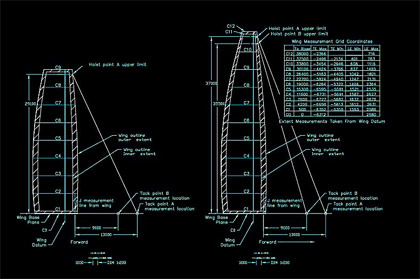
Short (32.7m/107 ft) and tall (40m/131 ft) AC72 wings.
Image: Class Rule/americascup.com

“That was one of the more challenging technical aspects of the rule, to come up with something that could fly a hull in five or six knots, but also race effectively in 28.  We ended up with a wing that was a moderate size and some large headsails so you could vary your sail plan area by quite a bit through the range of conditions.  We thought that you could still survive in 30 knots, but for anyone who’s raced around the buoys in 30 knots, it is pretty much survival at that point.”

Rather than compromise excessively on the new boat, several options for adapting wing sails to the conditions were considered, and the resulting AC72 Class now provides for two wing sizes.  A tall wing can be used in lighter breeze, with the shorter wing employed in the types of higher winds that kept the old ACC boats at the dock.

“The short wing came in toward the end  the feedback we were getting was that guys would rather be able to race hard in 25 or 30 knots, so we looked at the concept of removable tips at the top of the wing, above the forestay, but the more we researched it we didn’t think it would be effective.  So we thought a short wing would be preferable solution.

“It’s not something you have to have in 2012, but in 2013 you have to show up at events with a short wing,” Melvin says.  “All that is a protocol issue, so I would imagine the call for a short wing would come the night before a race.

The two wing sizes each have corresponding jibs, code zeros and gennakers, which shall not be intermixed — bringing up still more questions that Melvin and his team could not answer in the four months they had to write the Class Rule.

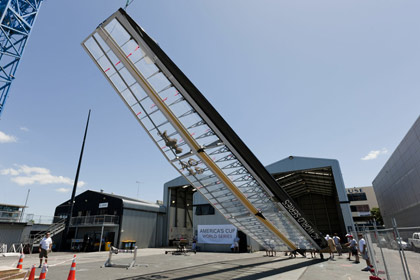
Setting up the AC45 wing for the first time.
Photo:©2011 Gilles Martin-Raget/americascup.com

“We thought about whether we should do more research into logistics for this rule, but we decided that the task of writing a rule in four months was big enough — to design a logistical program was asking too much.  We were a pretty small team, so we knew that all the good ideas were not going to originate with our team.  Once the rule was out, incredibly bright people from all these teams would start to figure it out.  So the logistical team goes from 10 people to 100 plus people.  We thought that was a better way to let it naturally evolve.”

In absence of hand-on experience with the AC72 in a regatta setting, how the teams and race organizers handle the big cats will indeed be a learning experience.

“Also under discussion is whether or not to take the masts out at night and how quickly teams should expect to have to change from the tall wing to the short wing,” says Melvin.

Knowledge gained from BMW Oracle’s wingsail experience is only of limited help, but Melvin believes the America’s Cup community will progress readily up the AC72 learning curve and gain confidence in how to deal with them.

Working out ways to moor the AC45 in the Viaduct.
Photo:©2011 Gilles Martin-Raget/americascup.com

“BOR90 developed ways to handle the wing, which was over 200 feet tall.  It was scary taking that thing up and down, because of its sheer size and all the unknowns involved, so it was very stressful.  These boats are quite a bit smaller.  The Stars and Stripes boat from 1988 is closer in size to the AC72, at 60’, and the owners down in Mexico keep it on a mooring.  That seems to work very well most of the time, so, unless you have some extreme weather coming in, the easiest way to park the boats would be in a mooring.  As the teams get more comfortable with the boats, all these perceived issues will go away.”

What did get written into the rule was a large amount of media-specific design, courtesy of Stan Honey, chair of the media development group.  Melvin believes it’s a good move on the part of organizers to focus on the media presentation, to put viewers right on the trampoline of the boat as it screams across San Francisco Bay.  The AC72 Rule requires provisions for no fewer than seven High Definition agile mounted cameras, three platforms for camera operators with handheld High Definition cameras, and 18 microphones for surround-sound, plus two media bays for cases, cabling, batteries, etc.  This equipment is provided by the America’s Cup Regatta Management and unlike past America’s Cup’s none of it can be turned off by the competitors.

With the AC72 Rule officially adopted, these days Melvin has taken off his writing hat and replaced it with his designing hat, working with a heretofore-unnamed Cup team on their first boat.  Leaving so much up in the air is great for the rule writer, but for the designer?  Not so much.  Some might wonder about a conflict of interest when a Class Rule author becomes a designer of that very same class, but for Melvin the design task is no easier because of it.  He faces the same questions everyone else does.  It’s difficult to know for sure which paths to pursue with the new boat.

“The courses have not been developed.  I know with the AC45s, they’re planning some innovative courses and will do some experimentation there.  It is a little bit tough, now that we’re working on designing one of these boats, we’d like to know what the course looks like, whether we’ll have reaches or not, whether you want to design the boat so it’s faster downwind or upwind, or what the right blend there is.”

In the current Protocol, the courses are due to be announced in December of 2011, but designs of the first AC72’s will already be committed at that point, with the boats far along in the construction process and nearing launch.

“There’s no time to understand what the courses are before you design your boat.  I really hope they revise that and move that date closer so that when you’re designing your boat, you know.  But I’m not sure if that will happen, so it’s a little bit of a guessing game.  In some of the meetings, they have showed some prospective courses to some of the challengers, and they involve reaches and even downwind starts, things like that.  So it’s all up for grabs right now.”

How do you proceed with a boat design amid that degree of uncertainty?

“Right now, I think you’d better be designing a boat that can do everything well, being able to switch gears and have some ideas on how you might mode your boat for different kinds of courses.

“The fun part for us is doing all the ‘what ifs’, just getting our heads around the rule as it exists, thinking of what the boat might look like and coming up with conceptual ideas, investigating different ideas.

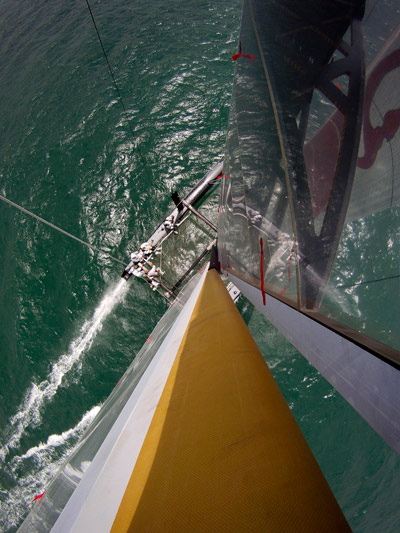
AC45, View from the top.
Photo:©2011 Gilles Martin-Raget/americascup.com

“One neat thing about it is it’s as much a management competition as it is a sailing or design contest.  If you just hire a group of designers, put them in a room and say ‘design this boat,’ you could have people going off in all sorts of directions and looking at all sorts of cool stuff, but in the end there’s a budget.  And most important is time.  This conceptual phase is extremely important.  You realize there are some things that we think could be interesting, but we’re not going to have time to look at that.  When it’s all new, there are so many things going around everyone’s heads, so many things you could look at and investigate, but you’ve really got to quickly boil those down to the things that are really promising and will give you the best return and get you across the finish line first.”

The question that will linger, if only because definitive proof will take until 2013, is what will a full-bore Louis Vuitton Cup and America’s Cup be like in a multihull class?

“I think that after the match in February [2010], there was a lot of opposition to having multihulls in the America’s Cup.  But over the course of time between February and the release of the rule in October, more people had become open-minded about it.  If you can change a person from being a monohull fan to multihulls, I don’t know.  But I think people are willing to have an open mind, let this process play out and see what happens.”

Melvin knows how much is at stake here — including a lifelong reputation as a guru of multihulls.  He also knows that many America’s Cup fans and participants alike have a way to go until they are convinced that a multihull will do justice to the event in which they are so invested.  All Melvin asks is ‘Give this a chance’.

SAN FRANCISCO BAY AND THE AMERICA’S CUP

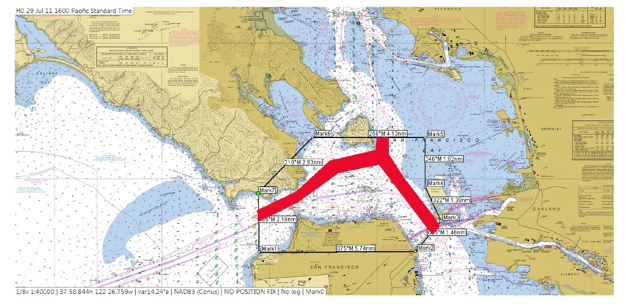
It seems to me, if I am reading this correctly, that the America’s Cup will interfere with any any all shipping or use of the channel in the bay.

I will note that in Newport, RI it would be the same. In order to make the races easily visible to people on shore it would be necessary to disrupt most every other use of the water.

Regatta Notice No. 2011/04

Competitors for the 34th America’s Cup

31 January 2011

Announcement of the America’s Cup Racing Area in San Francisco

1. Introduction:Article24.3 requires the Regatta Director to announce to Competitors the racing area on San Francisco Bay by 31 January 2011 for the Challenger Series, the Defender Series (if held) and the America’s Cup Match to be held in 2013, to facilitate Competitors’ design of their competing yachts.

2. RacingArea:Pursuant to Article24.3 of the Protocol Governing the 34th it is intended that courses for America’s Cup Challenger Selection Series, the America’s Cup Defender Series (if held) and the America’s Cup Match will be established within the following area on San Francisco Bay:

3. The above chart outlines the maximum area within which courses may be set. America’s Cup Race Management will work with the U.S. Coast Guard to coordinate activities with other users of San Francisco Bayand to ensure that the deepwater channel will remain open during the event.

4. FurtherInformation:Any questions or queries should be addressed to the Regatta Director, Iain Murray at iain.murray@americascup.com. This Regatta Notice may be supplemented by additional Regatta Notices.