
SPEEDBOAT

Speedboat aka Virgin Money is an exciting boat,an engineering marvel, elegant, extreme, powerful, fragile. Not particularly useful as its purpose can only really be to set or break distance records. Yet she requires a great deal of attention.

Below she reminds me of Windward Passage the 72 foot 1968 design by Alan Gurney, a practical sensible layout. Both were ahead of their time. Once again, if only today’s materials had been available to Alan; who knows what he might have created. the thought process was similar; go fast.
There is a difference in that Passage was built on the beach, There were limits to what someone would spend for a yacht. From that comparison the owners of Passage got a lot of bang for their buck. She was durable, still sailing, looking better than ever. In today’s world she is heavy and under canvased. I expect she will still be sailing after Speedboat is only a memory.
That said, Speedboat will soon leave to make an attempt on the Trans-atlantic record for a monohull. I would love to be part of that. After all it will only be six days; hardly time to establish a rhythm.

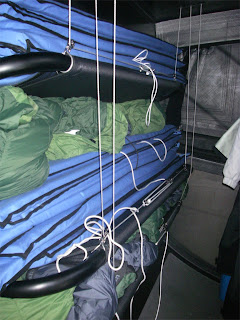
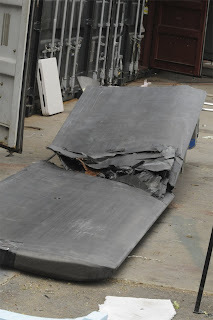
E scow

The E scow is still my favorite monohull. I haven’t sailed one in years. They were still wood. Modern materials have made these boats even more dynamic. If the materials available today had been available 100 years ago the yacht designers and builders would have been on cloud 9. They had the ideas, the means of expression was limited.

I owned one; here in Newport, however most of my E scow sailing was with Henry Bossett in New Jersey. We would trail his boat to Lake Murray, South Carolina at Easter break. It was always a great regatta, with a large turnout.

Bill Shay


Bill Shay was practically synonymous with the yacht “Carina” having sailed with the Nye family starting in 1956. Bill slept forward in the 1957 Fastnet race; which “Carina” won finishing when most of the fleet dropped out.

I met Bill in 1969 when I sailed on “Carina” in the Trans-atlantic race to Ireland. He was a great shipmate always ready with a can do attitude.

more wire tails

The entry about wire sheets reminded me of an incident while sailing on Intrepid in 1979. If you read far enough back in my blog there is an entry about my two seasons aboard Intrepid with Gerry Driscoll. It was an attempt by Gerry to come back in 1980 with Intrepid. It was contingent on finding financial backing. We were sailing against France 3 everyday, as Intrepid belonged to Baron Bic at the time.

We had no budget to speak of, so I would try to get an extra day or two out of the runner tails. They were 1/4 inch galvanized wire and took a great deal of abuse, particularly upwind tacking. Typically a set of runner tails would last 4 days, before they broke down.
Racing upwind on the fifth day of a set of runner tails; the windward tails exploded. Gerry,without a word, calmly tacked the boat. My arm was filled with small “splinters” of rusted wire, it stung. When we sorted out I looked at Gerry, who was still steering, not only was his arm covered with the same spikes, but one side of his face as well.
It was the last time I economized on runner tails.

Jack Sutphen’s book signing

Jack’s book:”Messing About in Boats” was published earlier this year. He was in Newport this weekend for a book signing in conjunction with the 12 Meter North American Championships, at the Seaman’s Church Institute. Lots of people turned out. I first met Jack in the 1960’s, he was working at Ratsey&Lapthorn sailmakers, as was Arthur Knapp. I raced against him on Long Island Sound.

Jack then showed up in Newport sailing 12 meters. He was very good at making a 12 go fast. He now lives in San Diego, and at 90 is having a great time.


wire sheets

When I started sailing rope sheets and guys were normal. The rope was not very sophisticated, it stretched quite a lot. As the boats became more evolved wire sheets and guys became normal. It was 7×19 galvanized, because it was more flexible. It rusted quickly and broke down just as fast. Your hands were constantly torn by the meathooks.

In the photo at the right, we are sailing Independence off Marblehead in March. It is cold. Ted Hood would just keep sailing in a straight line; often we would not return until after dark. For amusement, we would spray the wire on the drum just before casting off. It would flame, from the friction of the wire slipping on the drum in the tack.

bannister’s wharf


In 1977 bannister’s wharf was the dock for the Courageous/Independence syndicate. A lift was installed and we alternated boats in the lift.

I arrived early each morning as I was responsible for the mast and other components and left,usually before the sun set, unless we were making a major change. I never understood what the scene was like at The Candy Store and the Black Pearl. My only clue was the overwhelming smell of the garbage that greeted me each morning.
The 12 meter North American Championships are being held this weekend and hosted at Bannister’s Wharf.


VALENCIA


Valencia is probably best known as the site of the America’s Cup, at least to sailors. How do you really characterize a city as old and as beautiful and as diverse?

The column and ceiling are in the water board, dating from the 14th century. their job is quite literary to regulate the ebb and flow of water in the vast low areas surrounding the city. The fisherman set nets, rice is grown the oranges are irrigated.
As with much of Spain the Moorish influence is impossible to miss. The tiled rooftop is a glaring example, but the style is so woven into the fabric of the culture it is easily misunderstood.
The last photograph is of the house on an orange grove.