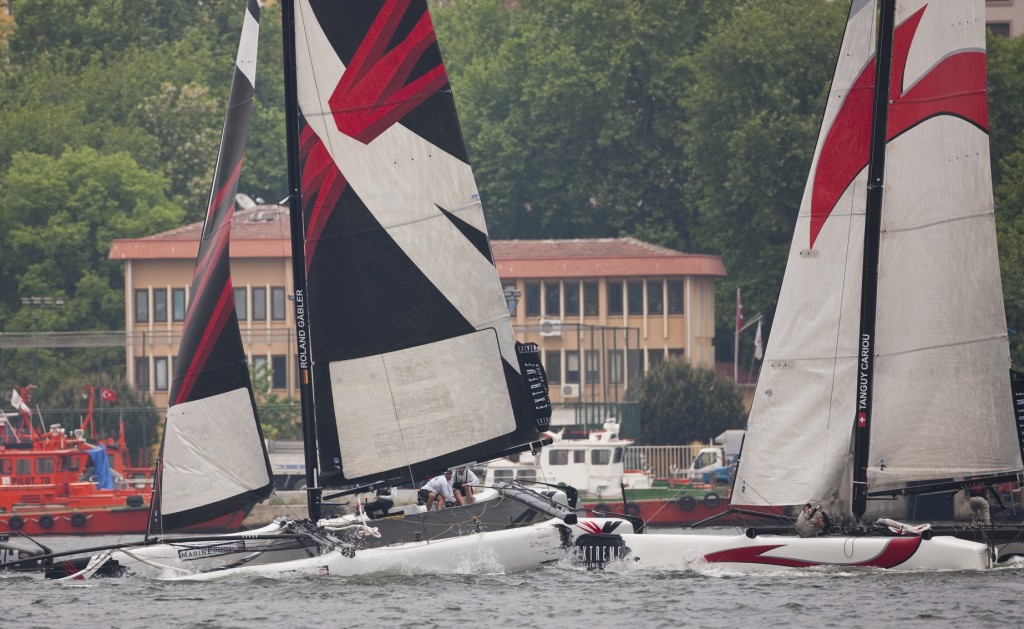
Are the organizers of the America’s Cup hoping that there might be some of these moments in the America’s Cup; Ala NASCAR? This collision took place during the Extreme 40 circuit in Istanbul, Turkey.
Are the organizers of the America’s Cup hoping that there might be some of these moments in the America’s Cup; Ala NASCAR? This collision took place during the Extreme 40 circuit in Istanbul, Turkey.
A symptom of too much change? Or simply of time zones? The Challenger of Record “Mascalzone Latino” has withdrawn from the America’ Cup. The position of the challenger of record is an important one. It is their job to co ordinate with the defender, in this case “Oracle” on almost all aspects of how the regatta would be conducted: and to represent the challengers as a group in this process. Vincent Onorato’s statement is below.
We could speculate about the “real” reasons for the withdrawal of the “Rascals”. Anyone who has been following the news of the America’s Cup has seen that Larry Ellison has gotten his way almost without interruption so far. Given his reputation it would not be hard to imagine that there has been little co operation. I would still contend that Europe would be a better venue for the America’s Cup; particularly in it’s present form.
The total number of teams is presently fourteen.
Dear Friends and Supporters,
with deep sorrow I have to announce my decision to withdraw my team from the 34th America’s Cup.
Since the very beginning of our role as Challenger of Record, I have been working on this project focused to bring the Cup in our Country.
Larry deeply loves Italy and he was excited about this idea. The Cup in Italy would have been the greatest worldwide promotion for our beautiful coasts. There have been some very high level and important meetings that made us believing in this dream, but the things went in a different way.
“As Challenger of Record, we have worked with humility next to Oracle and I am satisfied of the result we have reached: a new Cup, spectacular, with new boats, the catamarans, that will launch on the international scene a new generation of sailors.
With Russell we have discussed for long time on the most difficult challenge that the next Cup must face: an international situation with big economic crisis and therefore huge difficulties to find sponsor. This is the only, true, real enemy of the next Cup. We have then thought of the idea to create the class AC45, a concrete way to make lot of teams get involved in the event reducing costs, at least in the delicate period of the start-up.
On our side, I must thank the two Italian sponsors that believed and confirmed us their trust. We are not able, however, to reach a budget that allows us to be a competitive team.
In our sport, men in blazer have overcome by now those in oilskins, I’m a man in oilskin and when I go in the sea, I want to win. I’m not interested in a hopeless challenge, I would lie to the sponsors, to our fans and last but not least also to myself.
I would like to thank our friends from Club Nautico di Roma. I am sure that we will have new exciting adventures together.
The sailing adventure of Mascalzone Latino doesn’t end anyway with the Cup, but it continues with the sailing school in Naples, free of charge, for those children coming from the most difficult areas of this town. A daily challenge, and, who knows, maybe someday we will see a new America’s Cup champion coming out from one of them.
Fair wind to all of you.”
We know that 15 teams have submitted to challenge. Training on the 45 foot catamarans has been ramping up;but little has been heard about the inner workings of how the Cup would be handled by San Francisco. Here is a small preview.
|
For many of you this is the story of the America’s Cup. Stating the obvious; It’s about Television ratings. The rules of sailing have been altered to keep the flow. The races will likely not last more than a few hours at most. It fact the America’s Cup seems to be everything that Peter Wilson (a former America’s Cup sailor himself) was writing against.( see the previous entry)
The Cup is about money, not sport. Is it possible to reconcile the direction the Cup has taken and the direction sailors would like to see the sport take? I don’t see how. These forces are purposefully tugging in opposite directions. What is there to be done? Probably nothing, but to wait and see. The professional arm of sailing, for me is separating itself more and more from the sport as we know it. Is this a bad thing? All other sports have professional arms that operate independently from their respective sport; so why not sailing? Are we simply watching the growing pains of an emerging professional sport? I guess we shall see.
San Francisco needs to tell a new story for an America’s Cup win
San Francisco Business Times – by Patrick Twohy
Date: Friday, March 18, 2011, 1:31pm PDT – Last Modified: Friday, March 18, 2011, 2:20pm PDT
Photo: I Wilkins via Artemis Sailing
A Bay Area kid, Paul Cayard, is skipper of the Swedish team challenging for the America’s Cup.
S.F. has won the right to stage the next America’s Cup. So what?
Pulling off the same old white-shoe event custom made for a bunch of smug-looking stuffy old gents and their mega-millions won’t cut it.
Fortunately, no one here wants that. People here, particularly those associated with America’s Cup Event Authority and the city of San Francisco’s side of the deal, know this is a huge chance bring the America’s Cup and San Francisco as a major sailing venue to potentially millions of new fans.
But good intentions alone won’t turn around very traditional ways of doing things in a very old sport.
So how do you tell this story to new readers and viewers?
San Francisco and the America’s Cup Event Authority have to fundamentally reinvent not just the America’s Cup but sailing itself, partly in the minds of participants but mostly in the minds of those they hope to attract, particularly in the United States.
But what kind of story do you tell?
It’s all about the story
Given the massive click numbers on anything we post about the America’s Cup, it’s clear that Business Times readers understand the Cup is fundamentally a business story. That’s a good place to start — the business of America is business and all that.
But how do you get the attention of a broader U.S. public for whom watching golf on TV seems more exciting. (Golf on TV? Really? Isn’t there anything on the Paint Drying channel?)
For the tech-leading Bay Area, the America’s Cup is, among other things, a huge technology story.
It’s about how a remarkable — and remarkably simple — design made a sailboat that goes faster than the wind. Faster than you can safely drive through the S-curve on the Bay Bridge (especially if you’re hoping to catch a glimpse of the racing). Faster even than a U.S. Navy destroyer.
It’s a story about people like Stan Honey, a master navigator and Bay Area sailing icon who, not coincidentally, is also the inventor of the first-down-line technology that anyone who has watched football on TV is familiar with. He has been enlisted to help bring America’s Cup racing to life for the world’s TV viewers.
It’s about personalities
It’s a story about huge personalities (and egos), of course. Dozens of ’em. Start with Oracle Racing boss Larry Ellison. Then move to Paul Cayard, the Bay Area local kid (a graduate of Crestmoor High in San Bruno) who is CEO and skipper of Sweden’s bid to win the Cup.
It’s a story of many things. But there are a few things this story is NOT.
This is NOT primarily a sports story. Yes, the America’s Cup involves struggling against odds, challenging one’s self and one’s team to overcome, bringing your A game; giving 110 percent. Yada, yada. Snore.
Sports pages and websites are already full. If that’s the only place — or even the primary place — you’re looking for attention, well, best of luck to you.
Arrgh, drop the weird sailor talk
And surely, telling this story will have to involve NOT speaking the arcane language that sailors use to describe what they do.
Sailors speak of speeds in knots, directions in starboard and port, wind as pressure, turning as “coming about” — it’s like Steve Martin once said of the French, they have a different word for everything.
In some cases, those terms describe something more accurately than standard vocabulary can, the way “lateral” and “hail Mary” describe different ways of throwing a football. But in many cases, the only purpose sailors-only terminology serves is as a secret sailing handshake to keep the uninitiated out. Avast ye lubbers!
Hey kids, this is your chance at the bigtime. Climb down from your tree fort and join the rest of us. Tell us how fast boats are going in miles per hour. When they turn, it’s right or left, please. Wind is wind — not pressure. Or you’ll lose, no matter who wins the Auld Mug.
There are many ways the Bay Area and sailing could blow this chance to turn sailing into a more mainstream sport. One of the most obvious would be to inadvertently limit this to a story for people like me who already like sailing. And this chance is really much bigger than that.
Read more: San Francisco needs to tell a new story for an America’s Cup win | San Francisco Business Times
America’s Cup concerns unite environmental groups
‘It’s kind of all hands on deck’
San Francisco Business Times – by Eric Young
Date: Friday, March 11, 2011, 3:00am PST – Last Modified: Thursday, March 10, 2011, 5:09pm PST
Related: Sports Business, Environment
Spencer Brown
“This is a real unusual team effort,” says Deb Self, director of San Francisco Baykeeper.
Related News
Fearing the impact of America’s Cup crowds and construction, several environmental organizations and at least one influential neighborhood group have joined together to fire a warning shot across San Francisco’s bow.
The groups said the city’s plan to expedite an environmental study to stay on track for the 2013 yacht race has prompted them to coordinate efforts to monitor the city’s America’s Cup preparations. Their coalition, the America’s Cup Environmental Council, has not come out against the event — but it includes organizations that have been prominent in opposition to other projects, like the redevelopment of Hunters Point Shipyard
Read more: America’s Cup concerns unite environmental groups | San Francisco Business Times
The Tsunami is barely over and the world keeps turning. This article should come as no surprise to those of you who are familiar with the America’s Cup. But Newport should count their lucky stars that they were not successful. ( Governor Chaffee gave his state of the state address this past week and is looking for ways to close a large budget gap)
written by John Cote for the San Francisco Chronicle
(03-11) 04:00 PST San Francisco (03-11) 10:10 PST — San Francisco agreed to a deal that could cost the city millions more dollars to host the next America’s Cup regatta than the one the Board of Supervisors unanimously approved in December, according to a disputed report from the board’s budget analyst released Thursday.
San Francisco’s final agreement to host the prestigious sailing races was negotiated between race organizers and outgoing Mayor Gavin Newsom’s administration and port officials in the final days of 2010. The agreement was materially changed from the version the Board of Supervisors had approved two weeks earlier, despite city officials’ assurances that the agreement had not been fundamentally changed, the report by Budget and Legislative Analyst Harvey Rose said.
“We ratified a decent deal, but the proposal changed significantly by Dec. 31” said Supervisor Ross Mirkarimi, who commissioned the report. “The impact of those changes have been completely unknown until now, and those who negotiated on behalf of the city have some serious explaining to do. There were substantial increases in obligations and liabilities for the city.”
Members of the city’s negotiating team vigorously defended the final agreement Thursday, noting changes had been approved by the city attorney’s office. They also said Rose’s report was faulty.
“We tried to be fully transparent about the changes as soon as the negotiations were complete,” said Jennifer Matz, head of the mayor’s office of economic and workforce development. “The changes did not go beyond the scope of what we were authorized by the board to do.”
The deal approved by the board on Dec. 14 allowed for further modifications that did not materially increase the obligations or liabilities to the city. Rose’s report said that “some of the modifications represent material changes in process from what was approved (at the board).” Other changes could have “a material impact on port revenues and costs.”
Matz said she agreed with much in Rose’s report, but ultimately the changes did not materially increase the obligations or liabilities of the city as a whole.
The race is expected to bring more than $1 billion to the local economy, and the deal gives race organizers, led by billionaire Oracle CEO Larry Ellison, long-term development rights to up to three piers and another waterfront parcel in exchange for paying at least $55 million to shore up aging piers to house race facilities.
With a $55 million infrastructure investment, race organizers will receive development rights and a 66-year lease on piers 30-32, a single conjoined pier, and the deal commits the city to obtaining state approval to transfer title to Seawall Lot 330 across the Embarcadero to race organizers.
The team will also have the option of paying at least $25 million more to shore up nearby piers 26 and 28 in exchange for 66-year leases on them. It will also have the option of developing piers 16, 23, 27, 29 and 80 if the team’s improvements exceed $55 million and the city agrees to the development.
The report said the board did not agree to giving race organizers the right to unilaterally establish a long-term lease on Pier 29 or to changing the calculations for the rent race organizers would pay from a fair-market system to one locked in at $4 or $6 per square foot. Supervisors also did not sign off on the deal involving Seawall lot 330. The negotiated provision calls for the city to transfer the title of that parcel to race organizers. If that doesn’t happen, the city would lease that land to race organizers for 75 years for $565,000 per year, which is the same rent the port currently receives from a parking lot.
Rose, in an interview, said there were too many variations to give a total dollar amount that the changes represent for city coffers. One change – not requiring rent payments on Piers 30-32 because race organizers have committed to completing $55 million in infrastructure improvements – could result in the loss of about $2.2 million a year if race organizers are reimbursed for the $55 million through the rent credits and still owe rent, the report said.
Brad Benson, a port official and a central figure in the negotiations, said “the budget analyst is incorrect” in asserting race organizers had a unilateral right to lease Pier 29.
“It’s not a unilateral right,” he said.
A spokeswoman for race organizers said she had not reviewed the report and couldn’t comment.
Read more: http://www.sfgate.com/cgi-bin/article.cgi?f=/c/a/2011/03/10/BAL51I8SQ0.DTL#ixzz1GL5wWwOf
This is a subject that has been on my mind for awhile. The America’s Cup has developed racing rules for the Cup. They may create “flow” to the racing; for those who are not sailors and for Television. For me, it is tangential to the idea that sailing is developing into two separate and distinct classes. Professional and Amateur. It is a subject that has been discussed in earlier posts. This link to Matt Knowles blog discusses the subject with insight and clarity.
We may be watching the evolution of the sport before our eyes. So far I have seen no reaction.
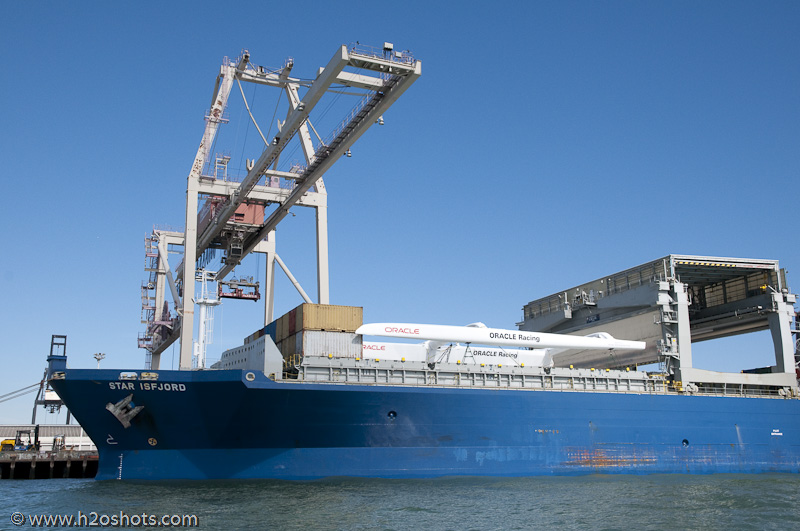
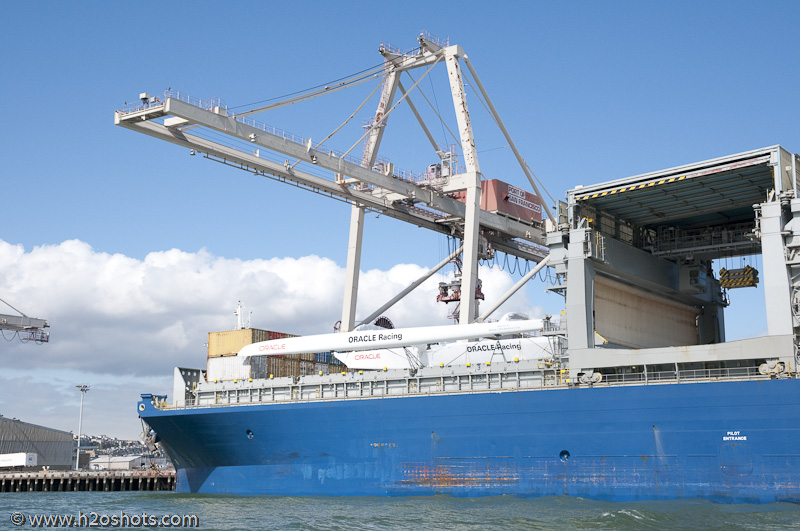
The engineering marvel of the 21st century has arrived in San Francisco. Perhaps this is the opening day event for the port. If you have an opportunity to see this boat do it. Pier 80.