
82 MILES BEHIND
Francois Joyon and IDEC after a second day of sailing are 82 miles behind the phantom Thomas Coville and SOBEDO despite reeling off 600 mile days. There is still plenty of time to make up the difference; particularly when you look at what Thomas Coville encountered in his final approach to the Lizard. The System the IDEC is riding seems quite stable.
SINGLEHANDED TRANSATLANTIC RECORD
Francois Joyon set sail on his trimaran “IDEC” yesterday from New York yesterday in an attempt to break the single-handed transatlantic record; presently held by Thomas Coville and Sobedo. He is, as I write 46 miles behind Thomas Coville’s pace. The record stands at 5 days, 19 hours 47 minutes, 20 seconds set in july 2008.
 |
| ‘Francis Joyon, IDEC’ © V. Curutchet / DPPI / IDEC Click Here to view large photo |
Francis Joyon initiated his attempt to smash the outright solo sailing record this morning at 09:15:20 hrs UTC (11:15:20hrs CET). In order to beat the current record of 5 days, 19 hours, 30 minutes and 40 seconds held since July 2008 by Thomas Coville on his trimaran Sodebo, Joyon and his maxi-trimaran IDEC will have to cross the latitude of The Lizard by 0445hrs UTC (0645hrs CET) on Monday 17th June.
The final 24 hours in New York were very stressful for the Breton sailor from Locmariaquer, as everything was a bit of a rush. He had to find a RIB to help him out of Gateway Marina, finish stowing supplies aboard, work on the final weather details… and once again, as we have come to expect, Francis Joyon in his usual style, took care of everything himself, while benefiting whenever possible from any kind offers of help from other seafarers on the pontoons. Once out of the bay off New York, the ‘big red bird’, IDEC was free to fly in the open waters of the Atlantic.
The SW’ly wind was blowing as forecast off Ambrose Light, and in spite of a heavy swell, Francis Joyon was able to speed off from the outset at record pace with the speedo stuck above 23 knots. ‘The swell was hitting us as we left Ambrose Light,’ Francis Joyon explained at lunchtime today. He was happy to be alone again at sea and relieved to have made it out of the Hudson and away from the shoreline without hitch, in spite of a few anxious moments. His final hours in the Big Apple were rather rushed.
 |
|
Francis Joyon, IDEC passing the Statue of Liberty – © V. Curutchet – DPPI – IDEC Click Here to view large photo
|
‘I didn’t have time to take care of all the supplies. I asked a guy on the pontoon to help me. He was Russian; he gave me some food from home. So it looks like it’s going to be Russian food this week…’
It was during the night that Francis got his boat away alone and removed the propeller, in order to head for the precise location, where we used to see the famous Ambrose Light. One last look around, the autopilot was switched on and the genoa trimmed… and Francis Joyon told the official from the World Speed Sailing Record Council, who was in New York, to start the clock for the big red trimaran. At 09:15:20 UTC (1115hrs CET), IDEC was off on her latest battle with the Atlantic.
‘The weather opportunity isn’t brilliant, but we will have to make do with that…’ Sounding light-hearted, once the decision had been taken in close collaboration with Jean-Yves Bernot, his accomplice on many a maritime adventure, Francis Joyon only wanted to look ahead to the next few hours. ‘I know that I should be getting some good conditions for the first two-thirds of the course, and according to the latest weather models there is some doubt about the finish, if we follow the route taken by the low-pressure area,’ explained Francis.
‘The route won’t exactly be the Great Circle route, as I shall be sailing a little further south. But on the other hand that means I shall be avoiding the worst fogs around the Great Banks…’ Fog, which has already engulfed IDEC in her first few miles of racing, forcing Francis Joyon to keep a close eye on the radar and over the bow of the boat.
 |
|
IDEC sets sail from NYC – © V. Curutchet – DPPI – IDEC Click Here to view large photo
|
‘I have just sailed between two whales.That was nice. They left me enough room to get through without having to manoeuvre…’ A 30-knot SW’ly wind is forecast ahead of the maxi-trimaran IDEC, with seas that are going to become increasingly tricky; Francis Joyon is facing a mammoth task and that is without taking into account the lack of sleep after a tiring voyage and a more or less sleepless night in New York. ‘It’s when I’m at sea that I get my rest,’ Francis reassured us…
STORM CHASER
GRANDSTANDS COMING DOWN
Artemis Racing, the Swedish sailing syndicate that suffered a fatal accident during training in May for the America’s Cup, released a scathing statement Monday regarding recently published comments from one its chief competitors, Emirates Team New Zealand.
Artemis characterized the comments as “out of line and unsportsmanlike.”
“In response to comments by Emirates Team New Zealand’s Managing Director Grant Dalton in a June 8, 2013 article in the New Zealand Herald, we would like to set the record straight,” the statement read. “Dalton’s proposals to change the (Louis Vuitton Cup) race would certainly not help Artemis Racing, as suggested, but make it even harder for us to compete.”
Dalton’s plan would start direct elimination July 19, rather than Aug. 6, and alter the format to eliminate the semifinals.
Late last week, Artemis announced that it would not be ready for the start of the Louis Vuitton Cup, the round-robin event that decides the competitor for Oracle Racing’s defense of the America’s Cup in September. The LV Cup was scheduled to start July 7. Instead, New Zealand and Italian syndicate Luna Rossa will start without their Swedish counterparts.
Artemis announced plans to join the racing in August, allowing time to rebuild its damaged boat and still make a run at the finals. Race organizers agreed to the new plan.
Dalton took exception with the race organizers’ accommodation.
“So the whole thing is now geared to the needs of the weakest common denominator,” Dalton was quoted in the article. “I wonder what would happen if the Rugby World Cup had to stop and reorganize itself in an unsatisfactory way because Namibia had a few injuries. How would that go down?”
Dalton wasn’t done, saying: “We haven’t lost sight of the tragedy and we have said we are in favor of the safety recommendations, but Artemis can get away with this because there are not enough teams in the America’s Cup. If there were five teams, they’d be goners; they wouldn’t be here. But because there aren’t enough, the regatta will have to meet their needs. … ”
Artemis racing found Dalton’s tone objectionable, prompting Monday’s statement.
“Dalton’s proposals benefit no team but his own, and his public insults are out of line and unsportsmanlike,” the statement read. “Artemis Racing’s May 9 accident set us back immensely – on a human level and a campaign level. As competitors, though, we may be down, but we are not out.
“Our passion for the America’s Cup remains strong. We are committed again to competing. Anyone who knows our sailors knows that our team will not shy away from a tough challenge. We are doing our best to recover and our target is to be ready for racing in the Louis Vuitton Cup’s semifinals on Aug. 6, if not earlier. In the meantime, the race schedule should remain unchanged and the derogatory analogies should be left on the dock.”
Emirates New Zealand released its response late Monday, stating: “The joint proposal put forth by Luna Rossa and Emirates Team New Zealand of starting the Louis Vuitton Cup later in July was done so in the hope of enhancing the event with a full muster of boats from the beginning, and therefore, placing more importance on the racing from the first race, something for which fans and sponsors are craving right now.
“Normally the challenger series of an America’s Cup is run on terms that meet the wishes of the majority of challengers,” Dalton said in the statement. “This is not the case here with Artemis rejecting the proposal and wanting to continue running an event schedule in which, by under their own admission, they will not compete in the early stages.
“Obviously, it was assumed that 10 weeks after the Artemis tragedy, that having previously taken delivery of their second AC72, they would be ready to race. This is not the case.”
The back-and-forth between the two teams was the latest wrinkle for an event that has had tragedy and controversy in recent months. In addition to the death of Artemis sailor Andrew “Bart” Simpson, who drowned during a training run May 9, the event has become shrouded with financial concerns.
Three competitors, down from an estimated dozen two years ago, remain to challenge for the Cup held by Oracle. That has resulted in lower estimates of the race’s economic benefits, and fundraising has slowed, meaning the city could be on the hook for significant expenses.
Grandstands coming down
America’s Cup officials said Monday they are refunding grandstand tickets for races through the Louis Vuitton Cup semifinals because of the uncertainty of when challenger Artemis Racing will be ready to compete following the deadly capsize of its first boat last month.
Depending on when Artemis returns, there could be only five days of racing between July 7 and Aug. 1.
America’s Cup CEO Stephen Barclay said it’s the right thing to do to refund the tickets and take down the grandstands until Artemis returns.
Once the racing is over, no one will remember most of the details. Meanwhile is is a bit clumsy and fragile organization.
LOUIS AMORUSO: MR. JT SHIP’S CHANDLERY
Louis W. Amoruso Jr., whose marine expertise and humor endeared him to generations of local fishermen, recreational boaters and competitive racers from around the world, died unexpectedly Wednesday, June 5, 2013. He was the husband of Carolyn Jessey Amoruso.
In 1959, the late J.T. O’Connell opened a hardware and paint store on Thames Street and sent Louie there to manage it. He had worked for O’Connell’s electrical department after being honorably discharged from the Army after the Korean War. A loyal and hardworking employee, Lou remained at work during Hurricane Carol in 1954, when water — and boats — from Newport Harbor washed against the top of the store’s door.
The hardware store was transformed into J.T.’s Ship Chandlery. The store became a landmark and its manager became a legend. In addition to supplying an international fleet of America’s Cup challengers and defenders with needed supplies, advice and equipment, Lou introduced many foreign yachtsmen to American, more specifically Newport, cuisine, culture and traditions. He was a longtime guide, promoter and good will ambassador for the City-by-the-Sea.
Lou was born in Newport on March 29, 1929, the only child of Louis W. and Alexia Gauthier Amoruso. He grew up at 472 Thames St., steps away from Newport Harbor and blocks south of the ship chandlery he later managed for 50 years. His grandparents had a grocery store and tailor shop next door to the family homestead; the buildings now house stores and restaurants.
He spent countless hours on the water, fishing and swimming. He joined the Army after graduating from Rogers High School and resumed his relationship with the sea when he returned to Newport. Lou belonged to the Newport Saltwater Fishing Club, which raised funds for the children of Meeting Street School and took them on annual fishing excursions. He served on the board of directors of the Rhode Island Striper Tournament and wrote a weekly fishing column for The Newport Daily News for many years.
Lou appeared in a Polaroid ad published in “Look” magazine and was featured in Kate Whitney Lucey’s “Born Newporters.” He was a member of the Newport Lodge of Elks and a former member of the Knights of Columbus. During his career at J.T.’s, Louie made many friends and fans associated with the Newport-Bermuda Race and became a so-called “agent” for the Bermuda Trade Council.
But for all his fame and success, Lou was first and foremost a devoted family man. He and Carol raised their family in their home on Eadie Street in Newport, where they lived for 50 years before the two moved to Middletown several years ago.
In addition to his wife of 60 years, Lou leaves his son and daughter-in-law, Louis and Holly Amoruso. He was the father of Kim Louise Amoruso McCarthy, who predeceased him in 2000, and the father-in-law of Edward “Ned” McCarthy.
He also leaves his grandchildren, Gina Marie, Alison Elizabeth, Kristen Koh Eun and John Nathan; his step-grandchildren, Alexander, Dominic and Francisco Amaral; his great-grandchildren, Nieema Louise, Lorena May, Arion Louis, Colby Louise, Daniel Avery, Olivia Elizabeth and Avery Elizabeth.
Calling hours will be held Sunday from 3-6 p.m. at the O’Neill-Hayes Funeral Home, 465 Spring St., Newport. A funeral Mass will be celebrated Monday at 9 a.m. at St. Lucy’s Catholic Church, 909 West Main Road, Middletown. Burial will be private.
In lieu of flowers, memorial donations in Lou’s name may be made to the Dr. Martin Luther King Jr. Community Center, 20 Dr. Marcus F. Wheatland Blvd., Newport, RI 02840, or the Rhode Island Community Food Bank, 200 Niantic Ave., Providence, RI 02907.
THEY JUST WON’T TURN UP
“They just won’t turn up,” said Kiwi boss Grant Dalton. “As part of the safety recommendations, the (US$100,000) fine (for not appearing in a race) has been waived and they can just keep on not turning up. It’s a Claytons schedule. I am not sure how they sugar-coated it in their statement, but Artemis vetoed the proposals. In the end, Artemis was the problem. They are the Challenger of Record and they can veto changes to the protocol – and they did.
“So the whole thing is now geared to the needs of the weakest common denominator,” said Dalton. “I wonder what would happen if the Rugby World Cup had to stop and re-organise itself in an unsatisfactory way because Namibia had a few injuries. How that would go down?
“We haven’t lost sight of the tragedy and we have said we are in favour of the safety recommendations but Artemis can get away with this because there are not enough teams in the America’s Cup,” said Dalton. “If there were five teams, they’d be gonners; they wouldn’t be here. But because there aren’t enough, the regatta will have to meet their needs and Luna Rossa are paying the price.”
The schedule has been amended so advanced ticket holders may be holding tickets to a non event.
The group, the America’s Cup Organizing Committee, is now supposed to raise about $22 million – down from an original $32 million – to defray the costs of things like permits, and increased police and Muni service. But it still owes the city about $800,000 on $1.6 million in costs from December. At the end of the month the group will receive another bill of about $3 million to $4 million for things like liability insurance, putting up railings around the perimeters of piers and signs to help cyclists and pedestrians find their way to the action.
“Am I the only one tired of hearing Tom Ehman spin the America’s Cup? The ‘Summer of Sailing’, which I was sorely tempted to attend, has now degenerated into “the Match is the big deal” “Adrian Morgan.
The America’s Cup, which appears to have been trying to separate itself from sailing since the creation of the “New” boats and format; supplementing the event with concerts and other events. The participants stated to me last year that they felt like characters in a sideshow.
The Annapolis- Newport race , Rambler and Donnybrook are already finished. Track the fleet HERE.
BERMUDA ONE-TWO
The Bermuda one-two started yesterday.
sailing into the leftover sea from Andrea,our first tropical storm of the year. Old friend Michael Millard sailing “Wildeyes” a quest 30 is doing well Click:HERE to follow his progress and everyone else. His boat was prepared by Bjorn Johnson, another good friend.
Destination: Bermuda Greenwich resident set to sail 635 miles of open water — alone
Anne W. Semmes
Published 6:08 pm, Wednesday, June 5, 2013


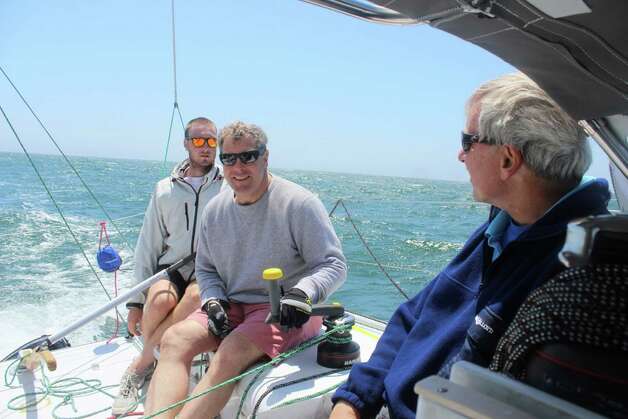 Greenwich resident Michael Millard has been busy preparing for the solo leg of the Bermuda One-Two Yacht Race, which begins tomorrow. Above, Millard, center, gets in some practice sailing off Newport last weekend with his son Ben, left, and his crewmate Bjorn Johnson, who will join Millard on the return leg of the race. Photo: Contributed Photo


Sometime tomorrow, Greenwich resident Michael Millard, 55, will sail his 30-foot yacht, “Wildeyes,” out of Newport Harbor in Rhode Island and begin a 635-mile journey during which he will challenge weather, wind and waves — alone — as part of the Bermuda One-Two Yacht Race. The trip aboard his Quest 30 (his eighth Bermuda One-Two) should take him three to six days, Millard says, depending on the wind and current.
“You’re crossing the Gulf Stream, and that is always a challenge,” says Millard, who will be matching his sailing skills in the race against some 28 other sailors.
Millard, who is taking time off from his job in mortgage finance to sail in the race, has been hooked on sailing for most of his life. His passion for blue water (or ocean) sailing, began, he says, when he was just a young boy setting sail with his family out of Indian Harbor Yacht Club. “Indian Harbor is known for its blue water sailors,” says Millard, who has been a serious sailor since the age of 16. “They’ve been a tremendous influence.”
Greenwich Citizen caught up with Millard before the race to learn more about the challenges of the Bermuda One-Two and what it’s like to sail solo in open water.
Q: Tell us about the Bermuda One-Two and why you keep sailing it.
A: It’s the premier single handed ocean race on the East Coast of America. Unlike the Bermuda Race, where each boat has a full complement of crew of six or more depending on the size of the boat, with the Bermuda Race 1-2, you sail solo on the outgoing trip and two-handed on the return. I’ll sail back with a long-time friend, Bjorn Johnson, from Rhode Island. He’s a past winner of the event. The Bermuda Race 1-2 is my favorite yachting event because it represents, in my opinion, the true spirit of yachting. It’s all about seamanship, the camaraderie of the competition and meeting the challenge. In other races that go on around the world, the race is about who wins. The competitors look for every advantage they can get.
This event is really about the camaraderie, the shared challenge we all face. Nobody remembers who wins these events. We don’t really care. There are electricians, people with homemade boats, investment bankers with custom-made boats. There’s Tom Donnelly from Stamford, who at 71 did his last race in 2003. He was the last to finish in the race — the winner was an 18-year-old. That’s why I continue to do it. There are some who look at short-handed sailing (one or two crewmen) as a lunatic fringe, but there’s not a crazy one among us!
There are two others from Greenwich sailing in the race. One is Eric Lecoq from Riverside. He’s a Frenchman — the French are known as the best short-handed sailors in the world. Eric is a little younger than I am. It’s his second time. He’s doing the race in a Class 40, a 40-foot specialized short-handed race boat. Joe Harris, who grew up in Greenwich and now lives in Boston, is also doing it in a Class 40. They’re usually skippering in essentially professional race programs but have been welcomed into what is a decidedly amateur race. I expect they will be super fast.
Q: How do you prepare for the race?
A: Since “Wildeyes” is a new boat, I’ve been sailing her since April 1 and doing as much sailing as possible. I had to qualify for this race by doing a 100-mile open ocean sail. I raced 60 miles out from Newport and back.
Preparation is key. There is no real hope of rescue if there’s a problem. There’s nothing between Newport and Bermuda. Generally, you don’t see any other sailors after the first six hours. But occasionally you sail the whole way with someone. This year, as I am sailing a smaller boat, I’ll be seeing other small boat sailors.
But it’s very competitive. Each of us has to be 100-percent self-reliant, and able to perform all the tasks on the boat, from navigation, to sailing the boat, to dealing with any boat repairs, and you have to think through everything that can happen: boat failures, bad weather, and navigating the Gulf Stream, which is key. You need to be in good physical condition. So, I’ve been training physically since November. I am a swimmer. You need a minimum of four hours sleep. I tend to take it in 1-hour increments. I sleep with one eye open. You get used to it — feeling the rhythm and feeling when it changes.
For the return leg of the race, the key is to find a good complement as a crew member. And Bjorn, who is crewing with me, is a trained engineer. He has prepared the boat for the event. I may be sailing solo, but I don’t do this alone — there are so many involved in my boat preparation.
I always approach this race with the attitude that the most important thing is finishing and the camaraderie of the group. The best I’ve placed is second. I’ve also placed last. But every year, I go in with high hopes.
Q: How does your family feel about your solo sailing across the ocean?
A: It’s tough on anyone in the family. I have to practice and train on the weekends. But I need my family’s support. My son and daughter are in college. My girlfriend is spectacular with her support. My girlfriend and daughter are joining me in Bermuda for a few days of R&R before we sail back. But people can follow this race online with the tracking system. You can visitwww.Bermuda1-2.org.
Q: Are you able to communicate with your family and with the other sailors?
A: Unlike most fully-crewed races where you are not allowed to communicate, the Bermuda One-Two competitors are encouraged for safety reasons to communicate over the radio, to share weather conditions. In 1997 there were no satellite phones — just radio communication, effective up to 10-15 miles. With the new satellite phones they work worldwide, but the urge is to communicate less. Each boat sends out a signal and is being tracked by trackers. That’s why you can see us online.
Q: What are some close shaves you’ve had in those earlier seven races?
A: The first year I wondered, `How will I manage to sleep?’ But sleep was a non-issue. My biggest problem was a boat issue. The hull was coming apart so I couldn’t sleep! When I arrived in Bermuda the other competitors helped me repair the boat. When we arrive in Bermuda we are busy preparing the boat for the return trip.
On my second race, the self-steering mechanism failed. With this in place, the boat is set to sail itself. It’s the most critical piece of equipment on the boat. I had a backup — a wind-driven system that saved me. But the most severe time was in 2009 on the return trip and I’m sailing with my son, Ben. He was celebrating his 18th birthday on that trip. We encountered horrible weather.
It was the most challenging of my career. That trip required all the perseverance and physical strength we could muster. We were 36 hours in the storm approximately midway. There were 35-knot winds and 10- to 15-foot seas. We hit something under us. We didn’t know what it was but it damaged the boat. This was followed with no wind for 48 hours. The main lesson my son got out of this is if you can survive this, there’s nothing you can’t do!
After that race, I decided to retire from this kind of sailing, to move off and do other things. But my son Ben is 22 now, and very competitive. He’s done three Bermuda Races. He’s done transatlantic racing. He inspired me to come out of retirement.
INTO THE WOODS






I report earlier in the week of my whirlwind tour of Acadia national park and Bar Harbor Maine. I was struck by the true beauty of the place. Curiously it reminded me of Yosemite. The same rock formations and evergreens. Clearly no Redwoods, but somehow the structure of the parks seemed familiar.