
Author: ws lirakis
a sailor who carries a camera
SNOW IN 49 STATES
There is snow in 49 states today; only Florida does not have snow.
ANDREW MASON ON AMERICA’S CUP TECHNOLOGY
Here is a link to one of the more interesting articles about the future of America’s Cup. For me the America’s Cup is and has always been about cutting edge yacht design. Frankly the gossip and “politics” are never very interesting; one always hopes that it is about the sailing, however naive that may seem.
The only point I might find to disagree with is the idea that the “C” class catamarans would not be an important platform for development. I agree with his observation that the “C” class cats have been budget constrained and have not used CFD for development. The class will non-the-less be an important point of departure.
ANYONE ELSE NOTICE THE RHETORIC?
* From Robert Bausch: (re, story in Scuttlebutt 3253)
What is it with this guy Tom Ehman, is he trying to jinx the America’s Cup
being in San Francisco? Now that we feel good that it is, he seems to be
trying everything he can to cast doubt on it happening, complete with sly
comments like “… if, for any reason, the deal with San Francisco falls
apart…”. Doesn’t he get it, that the Cup is going to be in the City?
OVER THE TOP HYPERBOLE?
You be the judge. I find it hard to compare Dr. Laura to Bernard Montessier, perhaps the author is just trying to create controversy.
NEARLY A MODERN DAY BERNARD MOITESSIER
Dr. Laura Schlessinger – who is based in Santa Barbra, CA – might be best
known as a nationally syndicated American talk radio host. However, she has
the sailing bug big time, and is finishing construction on a custom Tim
Kernan designed 46 footer that she plans to race in the March 2011 Newport
Beach, CA to Cabo San Lucas Race.
While having been largely committed to buoy racing, she first ventured
offshore nearly a year ago in a similar race to Cabo on her J-125 (Warrior),
winning overall in both ORR and PHRF. Here she comments on the experience:
———————————————————————-
I did the Cabo race purely for the adventure. I had never been out on the
open ocean and simply wanted the experience. By the end of the first day and
one-half, I was cold, damp, exhausted and generally miserable. I clicked my
heels but couldn’t get back to Santa Barbara. Then, on the second and
one-half day I got with the rhythm of it and can’t tell you enough how much
I absolutely loved it: huge turtles, whales, dolphin, the horizon with no
land and no other boats – it was just amazing!
We followed the progress of all the boats on the computer and we were well
behind our competition for most of the race. Ultimately – I didn’t care that
much because we all were having such a fun time with each other and with the
elements. I would guess that if the amount of laughter aboard a boat won a
trophy – we’d get it. On the last day I woke up from my four hour down-time
to find zero wind. I did see a shark fin and wouldn’t let anyone swim! We’d
gone way out to sea and were totally becalmed. I decided I was the “wind
witch” and would bring wind any moment now. They all scoffed at me – until I
pointed to some tiny cat paws on the surface of the water growing larger in
diameter. Suddenly, we started to take off.
The best part of the entire experience was that night when we were coming
into Cabo. I was driving (that’s my job) through the moonshine on the water.
It was so beautiful I was crying. Believe it or not, I turned to my crew and
suggested we forget the finish line and just keep sailing. I meant it – as
strange as that may sound. I got voted down, so over the finish line we
came. From the day I suggested we do that Cabo race, I never considered the
possibility of winning. I just wanted the adventure. And this year, we are
doing the Cabo race to qualify for Transpac – talk about an adventure. —
http://www.nhyccaborace.com/nhyccaborace/Profiles.html
——————————————————-
THROW A DOG A BONE,MAYBE?
Does this sound like playing both sides? Up is the up side for Newport?
Newport may get America’s Cup pre-regatta races
01:00 AM EST on Saturday, January 8, 2011
By kate bramson
journal staff writer
Ehman
PROVIDENCE –– Newport’s loss of the America’s Cup final Match races behind them, state leaders and Cup officials went back to the drawing board Friday to try to hammer out a deal to bring pre-regatta races to the City by the Sea.
“Now it’s not a done deal, but I’d say … we’re probably 75 percent of the way there,” Thomas Ehman, head of Oracle Racing external affairs, said Friday at the State House with Governor Chafee at his side.
Ehman said he’s “confident” the state can complete negotiations with America’s Cup officials in the next couple of weeks, when he hopes to reach a final agreement.
Ehman said he traveled to Rhode Island this week with “two asks” for Rhode Island: Could the state be ready to host an America’s Cup World Series event this September and could the state be the Cup’s backup plan for the final Match races in 2013 if, for any reason, the deal with San Francisco falls apart?
“We don’t think there are any problems in San Francisco,” Ehman said. “But if for any reason it falters … we need — as prudent sailors, businesspeople, event organizers — we need a backup plan and from what I’ve heard today from … the governor and on down, everyone has said, ‘Yes, we think we can figure out a way to help you if on the small chance that happens.’ ”
The state’s not counting on such a fumble, but leaders are gearing up to become the site for pre-regatta races.
“I’m an America’s Cup fan,” Chafee said. “I was on the race course in 1983 in the seventh race, I saw on that tragic downwind when Australia II finally passed Dennis Conner’s Liberty and the Cup left Newport. I think our chances of getting it back are slim — Tom’s been very honest — in 2013. But there are other opportunities, and that’s what we’ve been talking about.”
State leaders said the World Series races would be an economic boon to all of Rhode Island. House Speaker Gordon D. Fox said it’s appropriate to try to upgrade Fort Adams State Park as the venue because the money would be spent to improve a state asset.
No one could say how much it would cost to bring the September regatta here — partly because discussions with Ehman before Friday had centered on costs for hosting the final Match races.
“We don’t know it,” said Richard A. Licht, director of administration. “We don’t know the specifics of what they need yet.”
America’s Cup officials are dreaming of a different kind of race to bring sailing to the masses, envisioning pre-regatta races as a way to build enthusiasm and momentum for the final Match, Ehman said.
They’ll call an annual series of four to six regattas, which will begin this summer in Europe and lead up to the final Match race, the America’s Cup World Series. At the end of each series, they’ll name a world champion, hoping to maintain momentum for the sport in between final Cup years.
Newport would be the first American location for the World Series, Ehman said.
“And the idea is that as soon as the 2013 America’s Cup is over, [they’ll go] right back on the racing circuit, back to Newport,” he said.
Also at the State House Friday, state Senate President M. Teresa Paiva Weed said state leaders hope the “glorious” facilities at Fort Adams will lure even more races to Newport.
“We want people spending money here,” the governor chimed in.
Ehman said the nine-day World Series regatta in Newport is tentatively set for Sept. 17 to 25.
America’s Cup organizers are negotiating for live television coverage — “not just on minor networks” — for that final Sunday of the Newport regatta, he said. Then Ehman, who calls himself a “proud former resident of Newport,” hearkened back to the days of America’s Cup glory in the city, recalling the first live telecast of an America’s Cup race was in Newport on Sept. 25 of the final year Newport hosted the race.
“When it went live on TV in 1983, that’s when the Cup really became a worldwide phenomenon, and that’s what we aim to do here with these America’s Cup World Series events, starting with Rhode Island,” Ehman said.
After the media fanfare subsided at the State House, he added: “It’s important to have a connection to the history and tradition of the Cup. … If we can make this happen, this is a cool thing for all concerned.”
WANDERING POLE
This dramatic movement of the North Pole is a significant event for almost everyone, never mind it’s impact on charts we sailors use.
Richard A. Lovett in San Francisco
for National Geographic News
December 24, 2009
Earth’s north magnetic pole is racing toward Russia at almost 40 miles (64 kilometers) a year due to magnetic changes in the planet’s core, new research says.
The core is too deep for scientists to directly detect its magnetic field. But researchers can infer the field’s movements by tracking how Earth’s magnetic field has been changing at the surface and in space.
Now, newly analyzed data suggest that there’s a region of rapidly changing magnetism on the core’s surface, possibly being created by a mysterious “plume” of magnetism arising from deeper in the core.
And it’s this region that could be pulling the magnetic pole away from its long-time location in northern Canada, said Arnaud Chulliat, a geophysicist at the Institut de Physique du Globe de Paris in France.
Finding North
Magnetic north, which is the place where compass needles actually point, is near but not exactly in the same place as the geographic North Pole. Right now, magnetic north is close to Canada’s Ellesmere Island.
Navigators have used magnetic north for centuries to orient themselves when they’re far from recognizable landmarks.
Although global positioning systems have largely replaced such traditional techniques, many people still find compasses useful for getting around underwater and underground where GPS satellites can’t communicate.
The magnetic north pole had moved little from the time scientists first located it in 1831. Then in 1904, the pole began shifting northeastward at a steady pace of about 9 miles (15 kilometers) a year.
In 1989 it sped up again, and in 2007 scientists confirmed that the pole is now galloping toward Siberia at 34 to 37 miles (55 to 60 kilometers) a year.
A rapidly shifting magnetic pole means that magnetic-field maps need to be updated more often to allow compass users to make the crucial adjustment from magnetic north to true North.
Wandering Pole
Geologists think Earth has a magnetic field because the core is made up of a solid iron center surrounded by rapidly spinning liquid metal. This creates a “dynamo” that drives our magnetic field.
(Get more facts about Earth’s insides.)
Scientists had long suspected that, since the molten core is constantly moving, changes in its magnetism might be affecting the surface location of magnetic north.
Although the new research seems to back up this idea, Chulliat is not ready to say whether magnetic north will eventually cross into Russia.
“It’s too difficult to forecast,” Chulliat said.
Also, nobody knows when another change in the core might pop up elsewhere, sending magnetic north wandering in a new direction.
Chulliat presented his work this week at a meeting of the American Geophysical Union in San Francisco.
JANUARY 15TH WITH JOE COOPER
“Cooper’s Winter Day of Sailing”
A day of thinking, watching and talking about sailing in the midst of winter
10:00: West Marine, Middletown: SEMINAR
379 West Main Road, Middletown, RI: No Charge
Sailing consultant Joe Cooper will present a seminar on preparing yourself
and your boat for your next longer passage. All of us are always dreaming of
taking our boats (and ourselves) on something a bit longer than we have done
before, be it out to Block Island, over to Nantucket, or up to Maine. For
many folks on the East Coast, a trip to Bermuda is the highlight of many
years of sailing locally. In this seminar, Cooper will address how to think
about pushing yourselves to go further.
Refreshments will be available.
12:30-14:00, The Daily Shake, Middletown: LUNCH
883 West Main Road, Middletown, RI (about a mile north of West Marine)
Treat yourself to a healthy lunch that every sailor should know about;
priced $6-$12 for high energy herbal tea, a nutritious meal replacement
shake, protein bar, and more.
15:00-17:00, Seamen’s Church Institute, Newport: O.S.T.A.R. 2009-The MOVIE
At the Seamen’s Church Institute (Newport’s best kept secret) located on
Market Square (between Bowens Wharf and the Newport Harbor Hotel and
Marina), in downtown Newport. Tickets: $20.00 per person with the proceeds
going to the Seamen’s Church Institute and the Short Handed Sailing
Association. Copies of the video will be available for purchase following
the screening.
The Original Single-Handed Transatlantic Race is the original solo ocean
race. Here Cooper introduces this 50-minute movie that was produced by Marco
Nannini, a competitor from the 2009 race, and his brother, a movie man. It
is NOT fire-breathing walls of water with pulsing rock-and-roll music a la
the VOR movies; rather, it is a measured & reflective look at the normal
folks who spend their own time and money putting together their dream of a
solo passage along the historic route in relatively normal boats, much like
the ones we own.
Refreshments will be available after the movie
Please register your interest with me, Joe Cooper at cooper-ndn@cox.net so I
can start a head count.
Thanks!
Cheers,
Coop
Joe Cooper
401 965 6006
Joe “Coop” Cooper
Newport Dream Nutrition
At the Daily Shake
883 West Main road
Middletown RI 02842
Tel: 401 965 6006
www.shopherbalife.com/joecooper
EVERYONE HAS A STORY
This story has allowed me the opportunity to express my long held thought that EVERYONE has a story. Over the years I have listened to many; this story had a happy ending. For the others we can only have hope.






INJURIES ON BOATS
I don’t know about you but I was one of those people who believed that people never got hurt on boats. (I never wore a safety harness until more recently in my life)
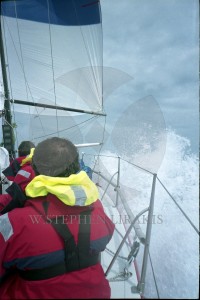
Somehow I link this topic with the idea that sailing is not really a sport. So how can one be injured sailing?
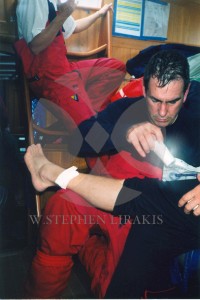
Long time friend Dr. Garry Fisher has had a long and abiding interest in injuries on boats and how to treat them and better still avoid them. He has written and spoken over the years on this topic; collecting statistical data on the subject.
Particularly with the evolution of yacht design, the behavior of the hull forms at sea has changed how we manage ourselves onboard. The motion of “newer” shapes is unfortunately conducive to more injuries. The clearest illustration of this are the Volvo 70’s.
Back to the “sailing is not a sport” idea; It was always a sport and like everything today that has only accelerated with time. Look at college sailing, and the ultimate challenge: Volvo 70’s. These are very physically demanding.
ARGUMENT FOR “IS SAILING A SPORT”
When we need information, we tend to use our favorite internet search
engine. And when the information cannot be found, there are websites where
you can ask your question. Here is what somebody asked on Answers.Yahoo.com:
“Okay, so I personally know sailing is a sport, although some a-hole in my
school (excuse my French) is deliberately trying to explain to me that it is
in fact not a sport because all you do is move a tiller around. Obviously
this is not true.
“His argument is based upon that he does not see any ‘professional sailors’
around on TV all the time, and he doesn’t watch Olympic sailing. He also
says he does not see sailing in the sports column on the internet. We argue
on the bus, and so far on the bus they say that sailing is not a sport (they
did a survey with five people), and I did admit it was not a popular sport
in America.
PROVIDENCE, R.I., Jan. 6 (UPI) — Seventy-nine percent of dinghy and keel sailors report at least one injury in the last year, but most of the injuries are minor, U.S. researchers say.
Study leader Dr. Andrew Nathanson of Rhode Island Hospital said 4 percent of the injuries were considered serious enough to require evacuation from the vessel and/or hospitalization.
“It’s important to note that nearly half of the injuries reported were minor and required no treatment,” Nathanson said in a statement.
Nathanson and colleagues surveyed 1,860 sailors who reported 1,715 injuries in the last year on small boats with crews of one or two called dinghies and larger ones with a crew as many as 16 — keel boats — like those used in the America’s Cup races.
The study, published in the journal Wilderness and Environmental Medicine, indicated the most common injuries were contusions, lacerations and sprains. Injuries were mostly caused by trips and falls, collision with an object or a fellow crew member, or being caught in the lines. Seventy-one percent of injuries occurred on keel boats.
“What is most alarming about this survey is the fact that only 30 percent of the sailors who responded reported wearing a life jacket,” Nathanson said.
Another concerning finding was that 16 percent of the sailors reported at least one sunburn, Nathanson said.