TRANSATLANTIC 2015

transatlantic race 2011 from ws lirakis on Vimeo.

snow-lion_4

Offshore racing: All-consuming and enormously energizing

A lot has changed in offshore sailing since Larry Huntington first raced across the Atlantic in 1957. Advances in yacht design, construction and materials have made the boats exponentially faster and more durable. Modern communications enable boats to remain in touch with other competitors and the rest of the world throughout the nearly 3,000-mile journey. But the essence of the adventure remains much the same.

“Going across the Atlantic is a fantastic change of pace from everyday life,” says Huntington, who is a former commodore of the New York Yacht Club, which will co-host the race with the Royal Yacht Squadron, in association with the Royal Ocean Racing Club and the Storm Trysail Club.

“It’s a chance to think about what Joseph Conrad wrote about the mystery of the sea. ‘The true peace of God begins at any spot a thousand miles from the nearest land.’ All of that goes through your head as you do this kind of adventure. It’s a wonderful time for reflection. It’s also intensely competitive. I find it all-consuming and enormously energizing.”

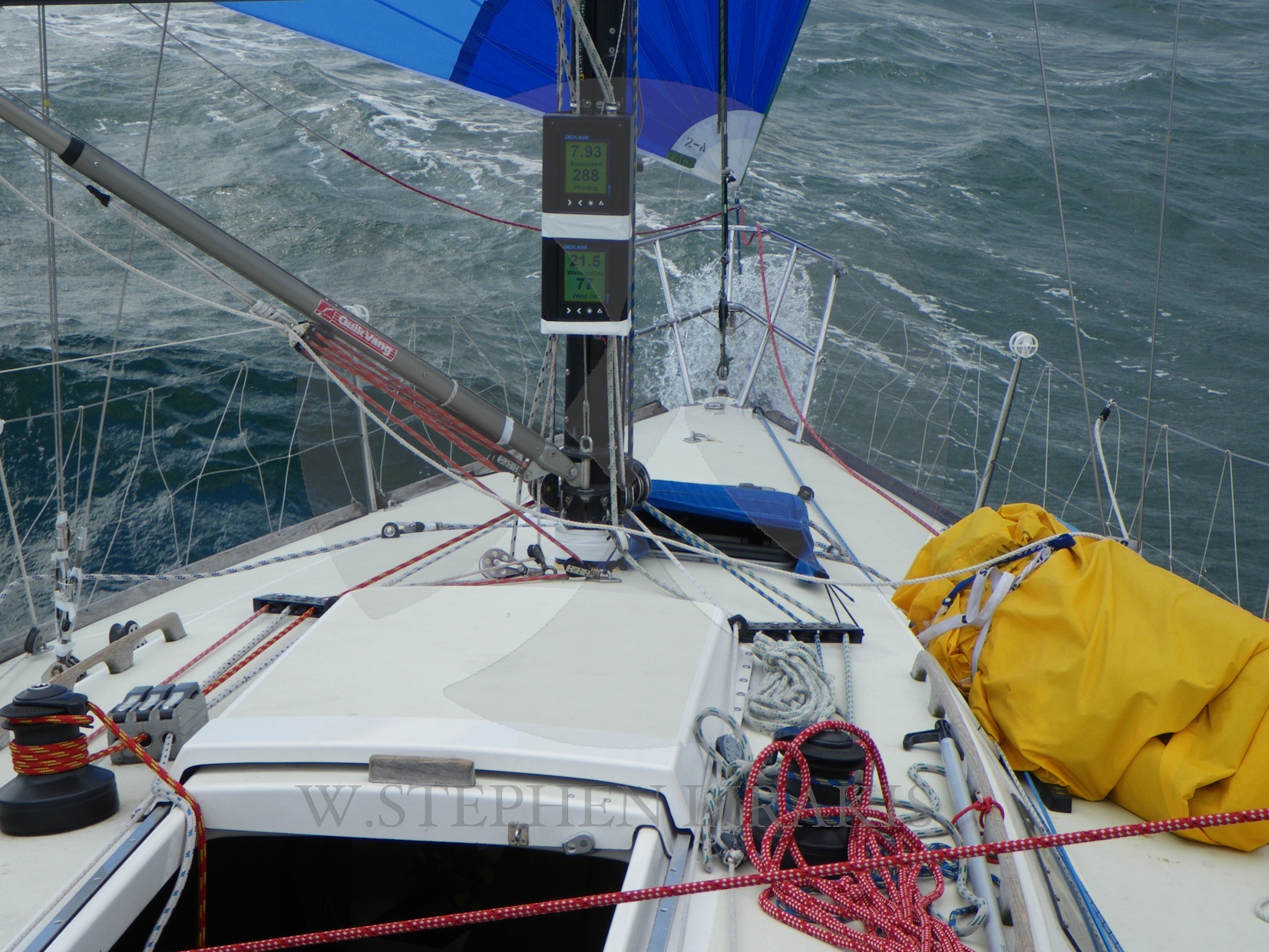
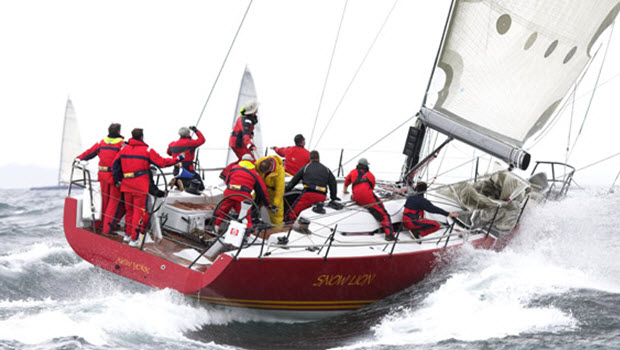
So it’s no surprise, that more than a half century after his first trip across the Atlantic, Huntington’s 50-foot Snow Lion was one of the first boats to enter into the 2015 Transatlantic Race, which will start from Newport, R.I., in late June and early July of 2015 and finish at Lizard Point, on the southwestern corner of England.

With 15 months until the first gun is fired from Castle Hill in Newport, R.I., more than 20 boats have entered and nearly 70 others have expressed interest. The fleet for 2015 is expected to reach its limit of 50 boats, nearly double the 26 boats that competed in the race in 2011.

“We’re extremely pleased with the significant early interest in this race,” says Royal Yacht Squadron’s Rear Commodore Yachting David Aisher. “The history of the transatlantic race dates back to the birth of recreational ocean racing in the late 1800s. More than a century later, it remains one of the ultimate tests of yachting skill.”

This will be the third Transatlantic Race for Snow Lion, a 50-foot boat designed by Jason Ker and built in 2006. There is an adage that says distance racers should never sail on any boat that is shorter in feet than their age. Huntington, who will be 80 when the race starts, clearly doesn’t subscribe to that theory.

“I had seen some of Ker’s previous designs and admired how they behaved and looked,” says Huntington. “We kept losing races to other Ker designs, so I figured [building one for myself] was a good thing to do.”

In 2011, it took Huntington’s team more than 15 days to complete the course. While that race was notorious for light and challenging wind conditions, the transatlantic course is still one of the longest regular races open to amateur sailors.

“First and foremost, you need a really compatible, competent crew,” says Huntington of the keys to success. “If you have full confidence in your shipmates, everyone gets the proper amount of rest and then you can address whatever Mother Nature wants to throw at you.”

Race website: www.TransatlanticRace.org

Tags: 

– See more at: http://www.sailingscuttlebutt.com/2014/04/01/offshore-racing-consuming-enormously-energizing/#sthash.NO8bexoc.dpuf

100 FOOTER

CLARK HATCHES A RECORD SLAYER

IN A QUEST TO PUSH OCEAN PASSAGE RECORDS INTO A NEW BENCHMARK, TECH GIANT JIM CLARK UNLEASHES A 100-FOOTER CURRENTLY DUBBED “NEWCUBED.”

By Sean Mcneill posted Feb 28th, 2014 at 10:46am

WHAT’S LENGTH GOT TO DO WITH IT? In the case of Jim Clark’s new ocean racer under construction at Hodgson’s Boatyard in Boothbay Harbor, Maine, quite a lot, or so says skipper Ken Read. Ken Read’s eyes light up when talking about Jim Clark’s newest ocean-racer project like a child at Christmastime who’s just unwrapped a Red Rider BB gun. The guilty pleasure lies in the fact that this is no ordinary 100-footer (if one can be ordinary). This yacht is designed to be a full-on record-breaker. You name the race or passage—Transat, Transpac, Bermuda, Fastnet, Hobart, to name but five—and it’s likely a target on their project whiteboard.

“This boat is going to be so cool,” says Read, Clark’s skipper and the President of North Sails who has experienced all types of campaigns—from J/24 World championships, to the America’s Cup and Volvo Ocean Race—in his decades-long experience in the sport. “This type of project isn’t for everyone, but it has a cool presence that will hopefully do the sport good, whether you’re a cruiser or a racer.”

Building a 21st century record-breaker is no small feat. It requires a plethora of designers to tank test scale models and run computer simulations, and there’s the “swat team” of boatbuilders to cook the pre-preg carbon-fiber hull and deck structures. All told, upwards of 32 people have contributed some input to the design and build through active participation or consultation. What will set this boat apart, says Read, is power, and lots of it.

THE BOAT WILL BE 100 FEET LONG WITH A DISPLACEMENT NEAR 30 TONS, BEAM IN THE MID-20S, AND A CANTING KEEL THAT WILL DRAW ALSO IN THE MID-20S.

They explored a lifting keel but determined it added too much drag for the desired upwind performance. Water-ballast tanks will aid stability, and fore and aft trim.

That makes it nearly identical in length, slightly lighter, and significantly wider and deeper thanWild Oats XI, the Reichel/Pugh maxi that has won line honors in the Rolex Sydney Hobart Race a record-equaling seven times. But with the mast stepped farther aft than Wild Oats XI, Read says Clarks’ yacht will look strikingly different.

“It’s going to be long, wide, and stable,” says Read. “With its power-to-weight ratio, there’s been nothing like it before. From a stability standpoint it’s a little stiffer, a little lighter, and with a little more sail area than Speedboat (the Juan Kouyoumdjian-designed 100-footer that’s now called Perpetual Loyal).”

FRENCH DESIGNERS

Clark’s as-yet unnamed yacht is from two French design firms, the renowned duo of Marc Van Peteghem and Vincent Lauriot-Prévost (VPLP), along with new star Guillaume Verdier. VPLP’s track record designing multihulls is second to none. Their designs include the giant multihullsGroupama 3 and Banque Populaire VGroupama 3 measured 103-foot LOA and shattered records such as the 24-hour, Transatlantic, and Trophée Jules Verne, only to see those records fall – in the case of the 24-hour record just one day later – to the 130-foot long Banque Populaire V. Verdier, meanwhile, had more concentration on shorthanded monohulls in the 40- to 60-foot range.

In 2007 the two firms joined forces to take on the highly competitive IMOCA racing circuit, for singlehanders in 50- and 60-footers, and they’ve had great success ever since, capped by stunning performances in the 2012-’13 Vendée Globe singlehanded non-stop race around the world. VPLP-Verdier designs placed 1-2 and took three of the top four overall. And they were fast: The race-winner, Macif, set a new, ratified 24-hour singlehanded distance record of 534 nautical miles at an average speed in excess of 22 knots, and the first two yachts completed the circumnavigation in less than 80 days.

“No doubt, this new boat is a development of Macif,” says Read. “The scale of a project like this, from an engineering and structural standpoint, is nothing like that boat. But the designers took shapes they liked from the IMOCA 60s and developed from there.”

Macif, however, was designed as a horse for the course. Racing around the world is more about close reaching or off-wind sailing. Clark’s new yacht will have upwind capabilities that could be necessary in short offshore races, those of 600 to 1,000 nautical miles. It will have two rudders, but the weather rudder won’t be lifted out of the water because rating rules prohibit such features. Clark’s yacht also won’t have the cut-back rail that Macif sported along its sheerline and which made the hull appear like an ellipsoid. The crew of around 20 (still being determined) requires a rail on which to hike.

FEWER CREW; MORE TO DO

The surprising part in all of this is that the yacht’s winches will be manually powered. Six pedestals will be mounted with custom bevel boxes to create specific gear ratios for the power necessary to trim the enormous sails. Read said the sail plan is still being finalized, but the A5 gennaker could measure in close to 1,000 square meters. The gennaker for Alinghi 5, the catamaran that contested the 33rd America’s Cup, was reportedly one of the three largest ever built at 1,100 square meters. And that cat had powered winches.

“Keep in mind that Banque Populaire V went around the world with no push buttons, about 50 percent more righting moment, and the same size rig as this boat, with one less pedestal,” said Read. “We did a study and found that we can produce as much or more power to the winches with 12 guys grinding than with push buttons. With manual winches, if we do a Transatlantic we can save up to a ton and a half of fuel and won’t have to keep the engine running all the time. Also, if we set a record it won’t have an asterisk next to it because of the powered winches. It’ll just be more fun to sail.”

It certainly will be fun to sail according to the VPPs. Upwind the boat is projected to sail at 13 knots, but at its sweet angle, about 120 degrees true wind-angle in 25 knots of wind, it’s predicted to average 30 knots.

One feature Verdier changed after testing five models at the Wolfson Unit in Southampton, England, was the bow profile. Macif has a very full bow, and initially that was the look for Clark’s new yacht. “Designers have poked around the concept of full bows for a while now. A boat like Macif or the VO70 Abu Dhabi were full bows,” says Read. “Verdier was much higher on the concept before the tank tests, and I think the bow got considerably narrower.

“It’s more specific to upwind performance than anything,” Read continues. “We think we’re coming up with ways to get the bow out of water when planing off the wind. Other concepts such as keel and daggerboard placement will help lift the bow, so we aren’t using as much volume forward to lift the bow. It’s not a narrow bow but not a full bow. It’s probably more conventional than any other boat.”

STRUCTURE AND SAIL PLAN

As of this writing the outer skin of the hull had just been laid up and the hand-selected work force at Hodgson’s Boatyard, led by Tim Hackett and Brandon Linton (the duo helped build Read’s two Puma-branded VO70s) was beginning to install the bulkheads. Read says that the yacht will be compliant with scantlings established by Germanischer Lloyd, the marine classification society based in Germany that strives to ensure safety at sea. There will be bulkheads every eight to 10 feet, and the boat is expected to pass the 135-degree vanishing stability test. While the sail plan is still in development, Read says there’ll be nine or 10 sails total. Aside from the mainsail and J2, the 100-percent headsail that will be hanked on, all other headsails will fly on roller-furlers and from custom stays. The headsails are all just different shapes of genoas or gennakers. There are no spinnakers on the boat because the apparent wind angle isn’t expected aft of 65 degrees. The material of choice is 3Di except the downwind sail, which is cuben-fiber.

“Sail area and mast height are all pretty darn similar to what Speedboat was,” said Read. “It’s fascinating how little horsepower you need. Once it starts building its own apparent wind, you almost can’t get the sail area off fast enough.”

With the mast so far aft in the boat, says Read, it’s quite possible the sail plan will extend beyond the transom.

“Where the sail plan sits over the platform is very different, almost more like *Banque Populaire V,” says Read. “There’s nothing that says the boom can’t hang off the back of the boat or that the traveler has to be in the middle of the cockpit. Nothing says the sail plan has to be forward in the yacht.”

ABOUT THE RECORDS

Quick quiz: What monohull currently holds the crewed west-to-east transatlantic record and when was it set? This writer was amazed to see that Mari-Cha IV, Robert Miller’s powerful 140-foot ketch is still the record holder. In October 2003, a crew of 24 took Mari-Cha IVacross the Atlantic in 6d:17h:21m at an average speed of 18 knots. The maxi catamaranBanque Populaire V holds the outright record at just over three and a half days, an average speed just shy of 33 knots, but Mari-Cha’s mark still stands some 10 years later.

Ken Read pulled no punches when saying that the Transatlantic record is among the marks he hopes to slay with Jim Clark’s new 100-footer. “The goal of this boat is to break records and be first to finish in the classic offshore races,” says Read. “This boat isn’t for around the buoys. The deck layout isn’t set up for it and the draft is too deep. We want to tick off every major race.”

They’ll get their first crack at a record later this year when they enter the Rolex Sydney-Hobart Race, where they’ll expect to encounter Bob Oatley’s Wild Oats XI, the seven-time line honors winner.

After the Hobart, other classic races on the radar include the Newport-Bermuda, Fastnet, Transpac, the Middle Sea Race, the Pineapple Cup (Miami to Montego Bay), and the Caribbean 600. Besides those and the Transat, they also plan a crack at the 24-hour record of 596 nautical miles set by Ericsson 4 in the 2008-’09 Volvo Ocean Race. And for the cherry on the cake, they might even attempt the non-stop, round the world mark. Banque Populaire V also holds that outright record, at 45-and-a-half days. The WSSRC doesn’t list a crewed monohull outright record (the round-the-world monohull records are singlehanded), but Read thinks they could do it in 55 days, give or take. “You don’t build a boat like this without throwing something like that on the table,” says Read. “We did a 42-day leg in the Volvo one year, so 55 days around the world isn’t too bad.”

677 MILES IN 24 HOURS, SOLO


Sodebo 24 1 2014 by lcoquilleau

BANQUE POPULAIRE, in the hands of Armel Le Cleac’h has set a new 24 hour record for singlehanded sailing; averaging 28.2 knots.

Thomas Coville aboard SODEBO is still behind the record singlehanded around the world set by Francois Joyon and IDEC; but not by much.

Lionel Lemonchois aboard PRINCE DE BRETAGNE is nicely ahead of the record from Brittany to Port Louis in Mauritius.

Classic French singlehanded sailing.

A WAY OF LIFE OCEAN RACING

A look back at the “Whitbread Around The World Race 1973-74”. I knew so many of the sailors and had been invited to sail the race myself; however life does not always follow our plans.
Life at sea is a way of life. The greatest change apart from the boats in the now “Volvo race” is perhaps the food. I used to say I ate better on a boat than I did at home. That is no longer the case.

THE WAY WE WERE

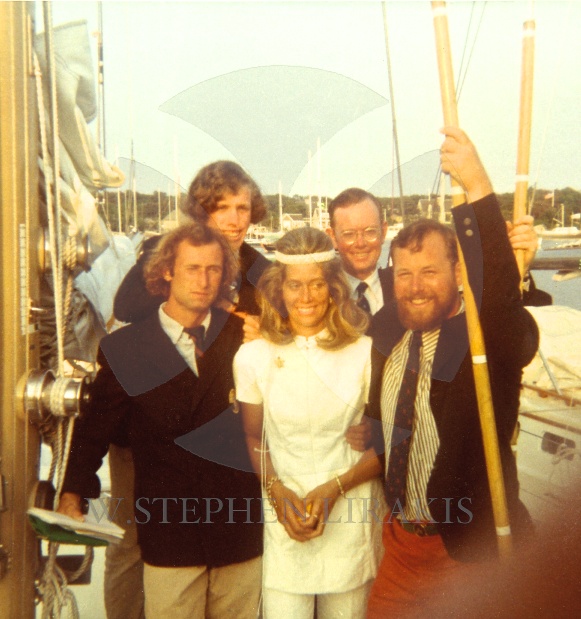
1971 STEPHEN LIRAKIS, JACK CUMMISKEY, MARTHA SMITH, RICHARD S NYE, CHRIS WICK
1971 STEPHEN LIRAKIS, JACK CUMMISKEY, MARTHA SMITH, RICHARD B. NYE, CHRIS WICK


This photo remains one of my favorites. A memory, a happy one; taken with a polaroid camera. I do not remember who took it.

We were in Harwichport at David Steere’s house. He was the owner of “Yankee Girl”, which along with “American Eagle” and our boat “Carina” were leaving the following day to sail to Cowes for the Admiral’s Cup and Fastnet Race. It was 1971. My good friend Mickey Spillaine was the pro on “Yankee Girl” and Joe Kennedy was his mate along with John Scott, a classmate from St. George’s.

We crossed the atlantic in 14 days, as I remember, we beat “Yankee Girl” and American Eagle” boat for boat by a day. They sailed a more southerly and warmer route.

This was before GPS. We navigated by sextant and dead reckoning. Crossing the Grand Banks in the cold and fog we had not had a fix in days. Dead reckoning put us about 20 miles south of  Sable Island. I was off watch when I felt something strange, we were running with a spinnaker at about 8 knots. My immediate thought was that we were going ashore on Sable Island. I leapt out of my bunk and headed on deck when there was a second bump.  I arrived on deck in time to see a whale pop up astern.


WEATHER AT SEA

TRANSATLANTIC 1975
TRANSATLANTIC 1975
TRANSATLANTIC 2003
TRANSATLANTIC 2003
TRANSATLANTIC 2011
TRANSATLANTIC 2011
TRANSATLANTIC 2005
TRANSATLANTIC 2005
FASTNET RACE 2003 FASTNET ON THE BOW
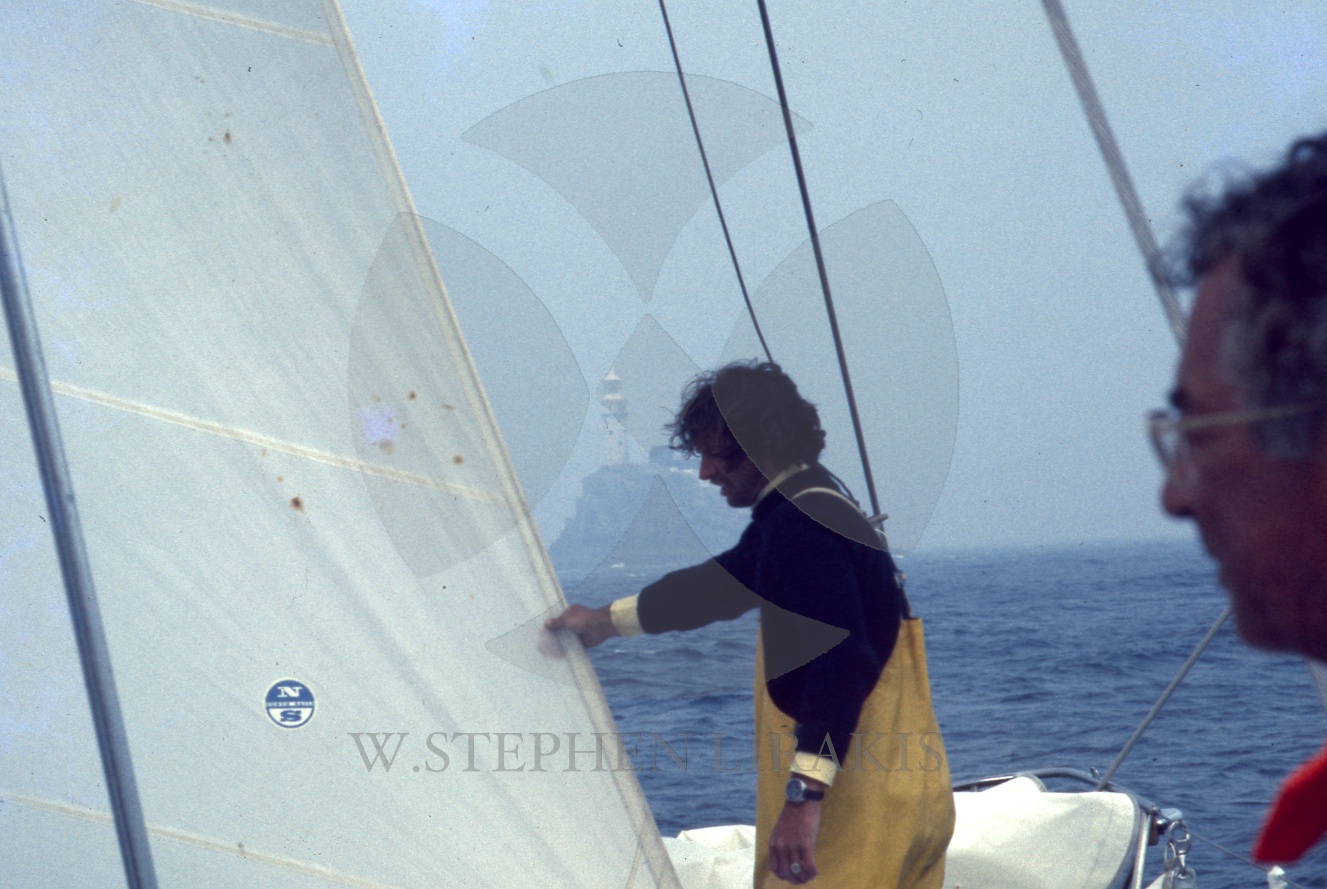
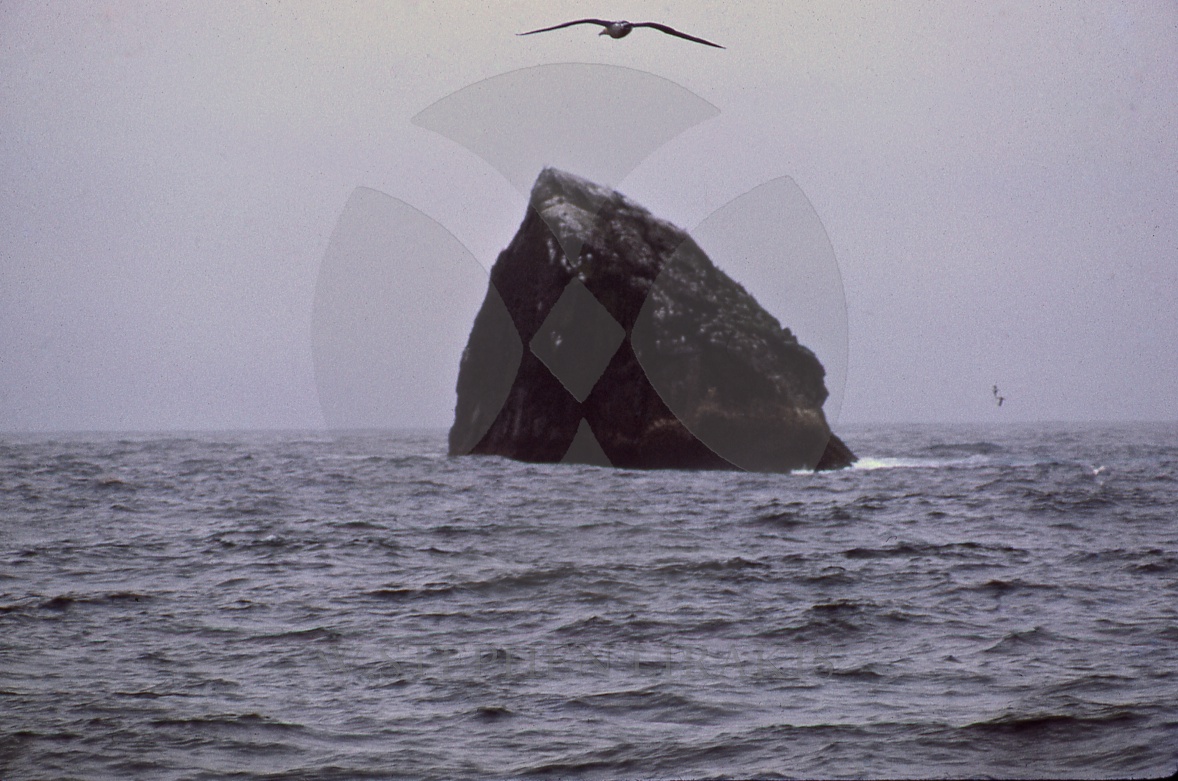
1973 FASTNET, ROCK ON THE BOW
1973 RUNNING IN THE SOLENT
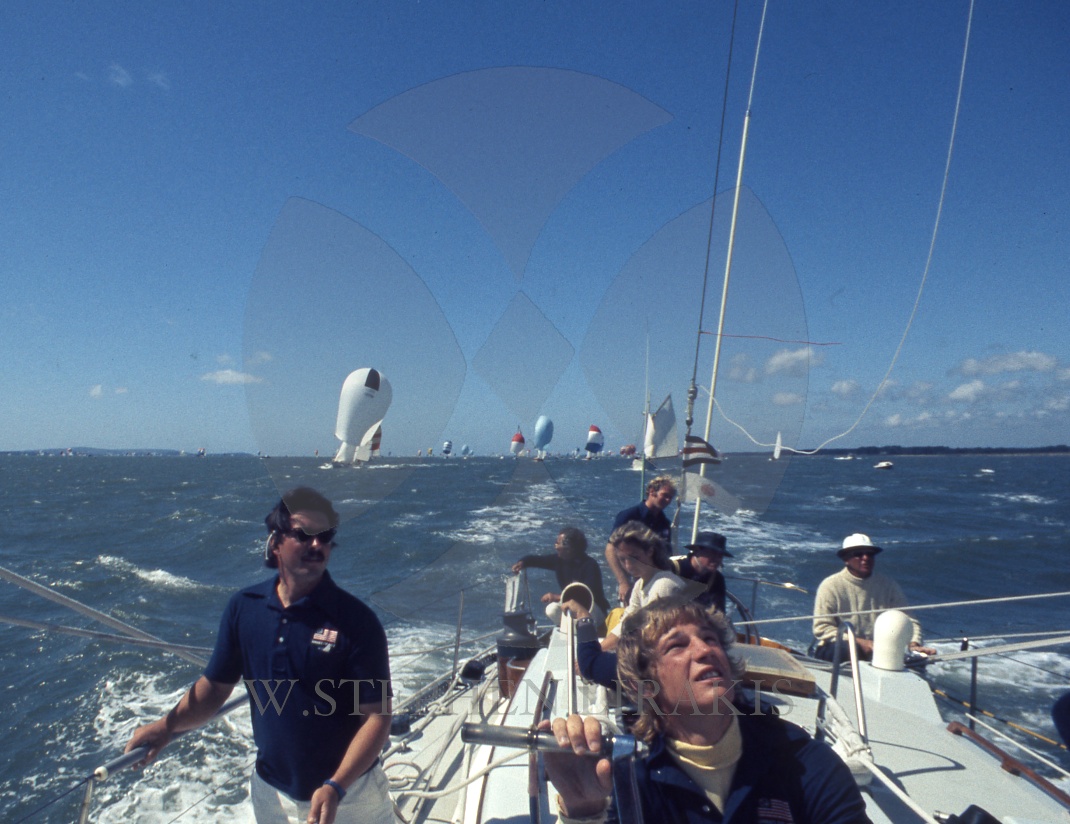
REACHING IN THE SOLENT 1969
TRANSATLANTIC 1968
TRANSATLANTIC 1968
BERMUDA RACE 1966
BERMUDA RACE 1966
BLOCK ISLAND RACE 2009

SINGLEHANDED TRANSATLANTIC RECORD

Francois Joyon set sail on his trimaran “IDEC” yesterday from New York yesterday in an attempt to break the single-handed transatlantic record; presently held by Thomas Coville and Sobedo. He is, as I write 46 miles behind Thomas Coville’s pace. The record stands at 5 days, 19 hours 47 minutes, 20 seconds set in july 2008.

‘Francis Joyon, IDEC’    © V. Curutchet / DPPI / IDEC    Click Here to view large photo

Francis Joyon initiated his attempt to smash the outright solo sailing record this morning at 09:15:20 hrs UTC (11:15:20hrs CET). In order to beat the current record of 5 days, 19 hours, 30 minutes and 40 seconds held since July 2008 by Thomas Coville on his trimaran Sodebo, Joyon and his maxi-trimaran IDEC will have to cross the latitude of The Lizard by 0445hrs UTC (0645hrs CET) on Monday 17th June.

The final 24 hours in New York were very stressful for the Breton sailor from Locmariaquer, as everything was a bit of a rush. He had to find a RIB to help him out of Gateway Marina, finish stowing supplies aboard, work on the final weather details… and once again, as we have come to expect, Francis Joyon in his usual style, took care of everything himself, while benefiting whenever possible from any kind offers of help from other seafarers on the pontoons. Once out of the bay off New York, the ‘big red bird’, IDEC was free to fly in the open waters of the Atlantic.

The SW’ly wind was blowing as forecast off Ambrose Light, and in spite of a heavy swell, Francis Joyon was able to speed off from the outset at record pace with the speedo stuck above 23 knots. ‘The swell was hitting us as we left Ambrose Light,’ Francis Joyon explained at lunchtime today. He was happy to be alone again at sea and relieved to have made it out of the Hudson and away from the shoreline without hitch, in spite of a few anxious moments. His final hours in the Big Apple were rather rushed.

Francis Joyon, IDEC passing the Statue of Liberty –  © V. Curutchet – DPPI – IDEC   Click Here to view large photo

‘I didn’t have time to take care of all the supplies. I asked a guy on the pontoon to help me. He was Russian; he gave me some food from home. So it looks like it’s going to be Russian food this week…’

It was during the night that Francis got his boat away alone and removed the propeller, in order to head for the precise location, where we used to see the famous Ambrose Light. One last look around, the autopilot was switched on and the genoa trimmed… and Francis Joyon told the official from the World Speed Sailing Record Council, who was in New York, to start the clock for the big red trimaran. At 09:15:20 UTC (1115hrs CET), IDEC was off on her latest battle with the Atlantic.

‘The weather opportunity isn’t brilliant, but we will have to make do with that…’ Sounding light-hearted, once the decision had been taken in close collaboration with Jean-Yves Bernot, his accomplice on many a maritime adventure, Francis Joyon only wanted to look ahead to the next few hours. ‘I know that I should be getting some good conditions for the first two-thirds of the course, and according to the latest weather models there is some doubt about the finish, if we follow the route taken by the low-pressure area,’ explained Francis.

‘The route won’t exactly be the Great Circle route, as I shall be sailing a little further south. But on the other hand that means I shall be avoiding the worst fogs around the Great Banks…’ Fog, which has already engulfed IDEC in her first few miles of racing, forcing Francis Joyon to keep a close eye on the radar and over the bow of the boat.

‘I have just sailed between two whales.That was nice. They left me enough room to get through without having to manoeuvre…’ A 30-knot SW’ly wind is forecast ahead of the maxi-trimaran IDEC, with seas that are going to become increasingly tricky; Francis Joyon is facing a mammoth task and that is without taking into account the lack of sleep after a tiring voyage and a more or less sleepless night in New York. ‘It’s when I’m at sea that I get my rest,’ Francis reassured us…

ALAN GURNEY

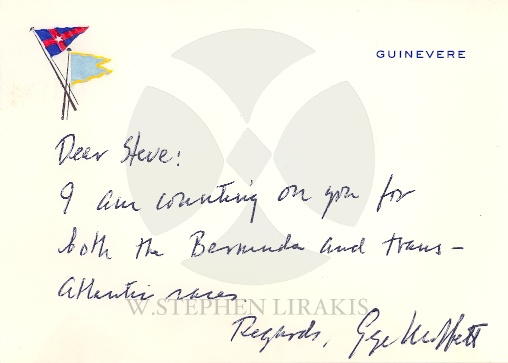
I sailed my first Bermuda Race with Alan Gurney aboard George Moffett’s ” Guinevere”, and the 1968 transatlantic race, as well as other races. We corresponded some in the intervening years, not recently however. I am left with that feeling of one more thing I might had said or asked.

I did hear from the individual who recently purchased “Guinevere” and is in the process of restoring her. The photos he sent she looked rather sad.
EIGHT BELLS ~ ALAN P. GURNEY
By Ted Jones
Alan Gurney designed boats the old fashioned way with drafting pencil on
velum, using splines and ducks (weights), a planimeter, and a seaman’s eye.
He thought like the water through which he had sailed, in England,
transatlantic, the USA, both polar regions and much of what lay in between.
As a young lad, he would make boats out of toilet tissue (which at that
time had characteristics of waxed paper) and float them in his bath. He
spurned a career in the army to pursue a career as a yacht designer, and
ultimately moved on to an early passion, Antarctic exploration. He had
amassed an impressive collection of hundreds of photographs of every known
Antarctic penguin species.

I had the great good fortune — a privilege — to be his friend, and to
have had lunch with him frequently as he was in the process of drawing the
myriad details of what was to become “Windward Passage”, the world famous
dream boat of lumber tycoon, Robert F. Johnson. During each lunch-time
visit, I would meet Alan in his basement studio on New York’s East 54th
Street, and he would show me the most recent drawings.

Johnson had selected Gurney for the new design having been impressed by the
performance of George Moffett’s “Guinevere”, a 48 foot Jacobsen-built
aluminum yawl which had won the SORC in 1966, the second of two ocean
racers Alan had designed for Moffett. The first was a wood-built boat, the
Nantucket 38, aboard which I had the sailed in the 1964 Bermuda Race.
Later, I transferred to Humphrey Simson for whom Alan had designed a yawl
similar to “Guinevere”, the 47 foot Derecktor built “Kittiwake”, aboard
which I sailed in the 1966 SORC, Bermuda, and Transatlantic races.
“Kittiwake” did well in her class in the SORC series, overshadowed only by
Ted Turner’s legendary Cal-40, “Vamp X” which won everything in her class
that year including the Transatlantic race from Bermuda to Copenhagen.

I had met Alan Gurney in 1960 following that year’s Bermuda Race. I was a
yacht broker in the office of Tripp & Campbell in New York City when
Englishman Gurney was brought around by G. Colin Ratsey (of the English
sailmaking firm) to meet yacht designer Bill Tripp. Still only 24, Alan had
won a prestigious competition for a modern “club racer” sponsored by the
British magazine, “Yachting World” which brought him to the attention of
Chesapeake Bay yachtsman Jack Lacy for whom Alan had designed a 35 foot
sloop. While nothing came immediately of the meeting with Tripp, both
partners at Tripp & Campbell had been impressed, and when Tripp’s design
assistant resigned a short time later. The firm offered the job to Gurney
who flew back to New York to accept it. — Read on:

BUT GEORGE, WE’RE RACING


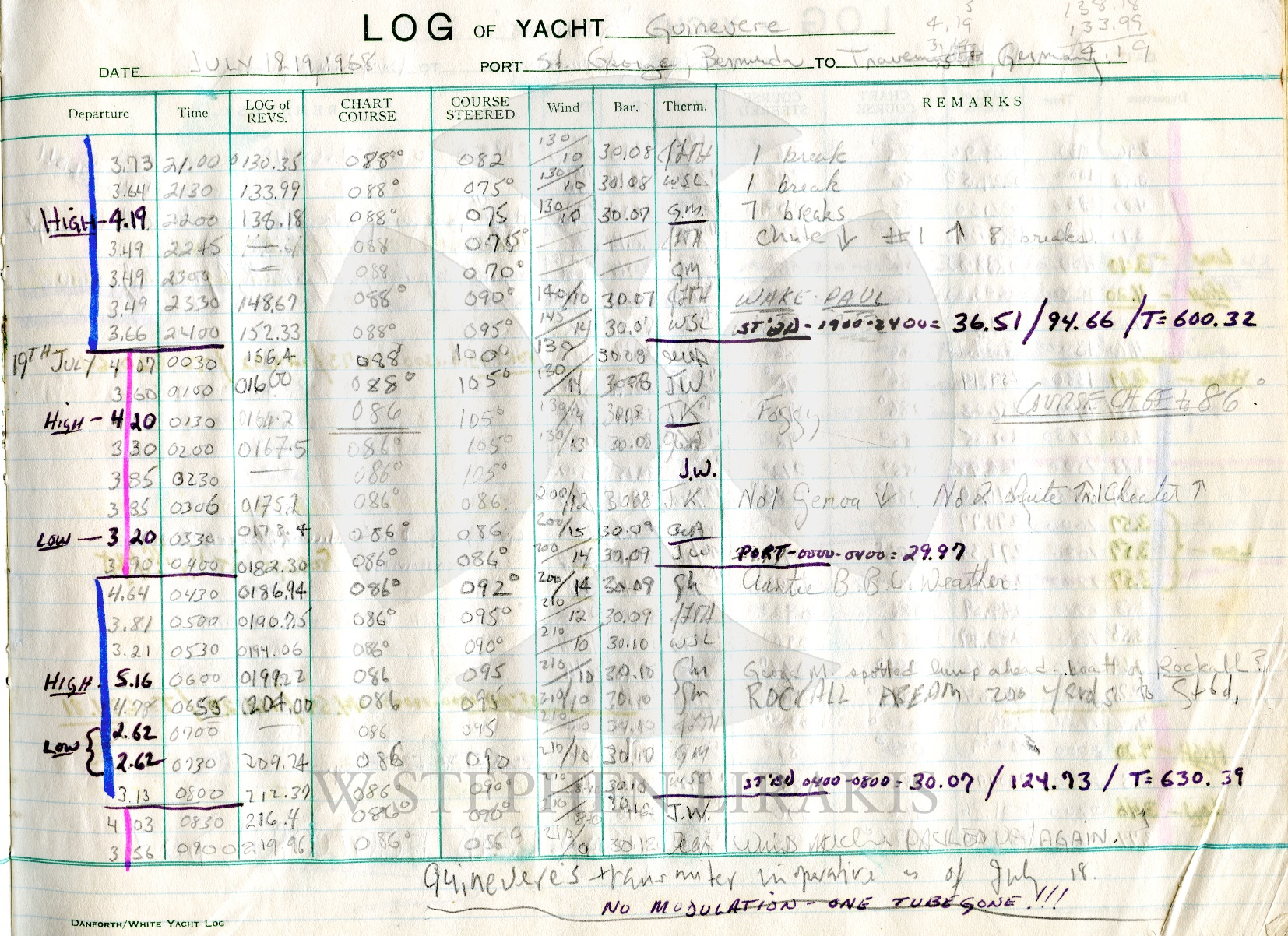
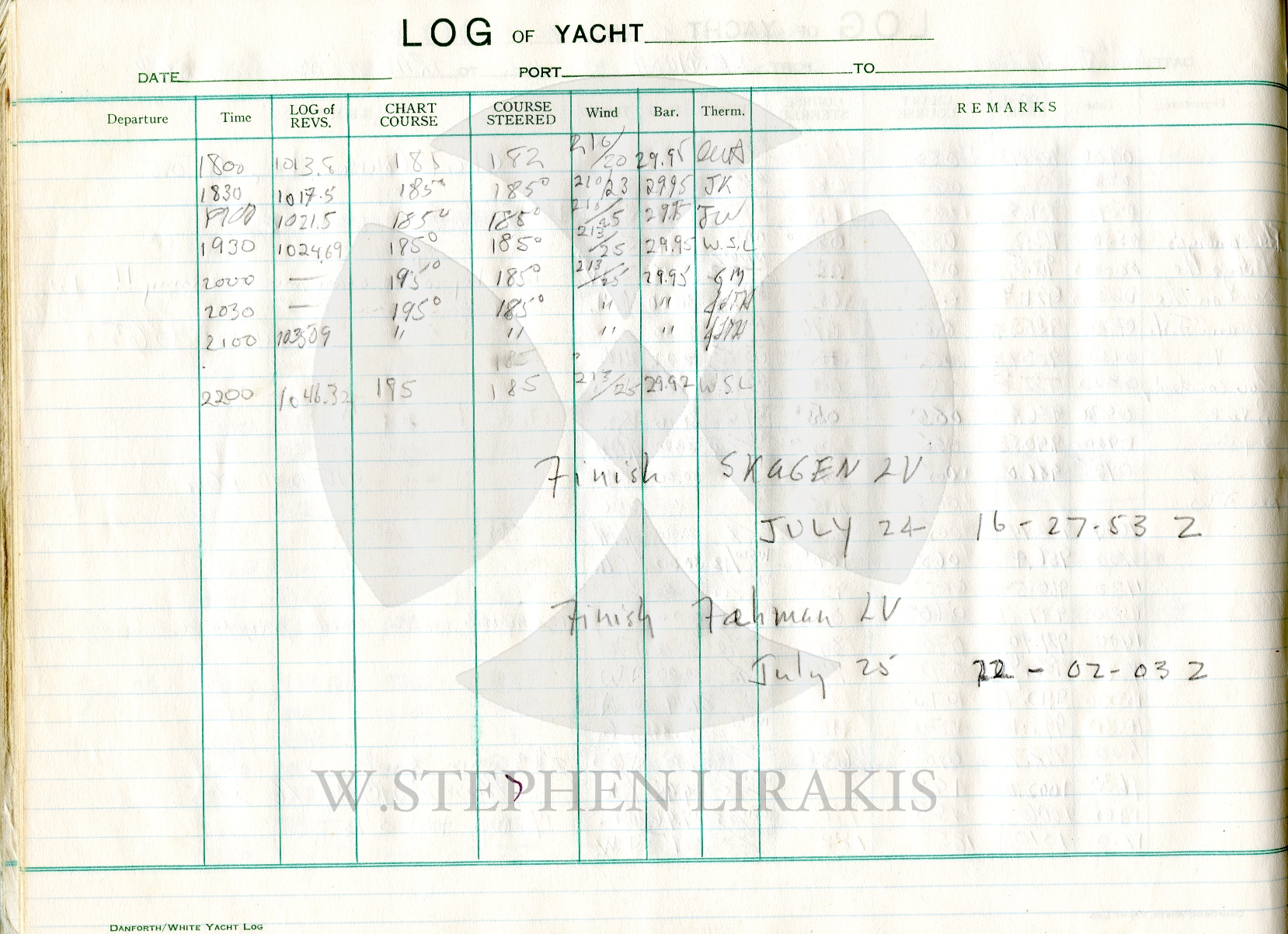
The transatlantic race of 1968 from Bermuda to Travemunde was my longest both in distance and time. It was 3,800 miles.  George Moffett was  a wonderful man, curious and interested and a fine sailor. As we approached the vicinity of “Rockall”, George said we should change course to see it, he was met by a chorus “but  George we are racing”. Without missing a beat George responded ” Who knows if we will ever be here again?” I have never been in sight again, although very close by on several occasions.

In this race our times were taken at two points; at the Skagen light ship and at Fehmarn lightship. Our finish times shown on the last log entry. Many stories, of ship life and the race from other boats still hold fond memories.